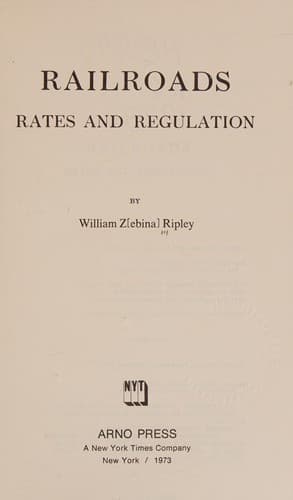
Railroads: Rates and RegulationsRipley, William Zebina
History
Railroads: Rates and Regulations
Ripley, William Zebina
Railroads -- Freight -- Rates -- United States; Railroads and state -- United States
It not infrequently happens that the initial railroad may entirely
control a roundabout route, whereas shipments by the most direct line
necessitate a division of the joint rate with other companies. In such
a case the initial line will naturally favor the indirect route, at the
risk of economic loss to the community and even to its own shippers. An
interesting illustration is afforded by a complaint of wheat growers
at Ritzville in the state of Washington concerning rates to Portland,
Oregon.[295] By direct line with low grades along the Columbia river
the distance was 311 miles. This was composed of several independent
but connecting links. The Northern Pacific on the other hand had a
line of its own, 480 miles long, which moreover crossed two mountain
ranges with heavy grades. It based its charges upon the cost of service
by this roundabout and expensive line; and insisted upon its right to
the traffic despite the wishes of the shippers. The Commission upheld
the shippers' contention for the right to have their products carried
to market in the most efficient manner.[296] Another instance on the
Illinois Central is suggestive, concerning shipments from Panola,
Illinois, to Peoria, a distance of about forty miles by the shortest
line of connecting roads. Yet the Illinois Central having a line of
its own _via_ Clinton and Lincoln transported goods round three sides
of a rectangle, a distance of 109 miles, presumably in order to avoid
a pro-rating division of the through rate.[297] Of course elements of
operating cost enter sometimes, as in the case of back-loading;[298]
but in the main, the pro-rating consideration rules.
Rebates may or may not be given in connection with circuitous routing.
Sometimes the same result may be obtained when one carrier merely
shrinks its proportion of a joint through rate, leaving the total
charge to the shipper unaffected. Of course it goes without saying that
an implication of improper manipulation of rates does not always follow
the diversion of freight from a direct line. The rate may be the same
by several competitive routes, shipments going as a reward for energy,
persistency, or personality of the agent. A recent case, concerning
rates on lumber from Sheridan, Indiana, to New York illustrates this
point.[299] Sheridan is twenty-eight miles north of Indianapolis on
the Monon road. Quoting from the decision:
"In the division of joint through rates on percentages based on
mileage, the defendant line naturally prefers arrangements with
connections giving it the longest haul and largest percentages.
Therefore, it carries this freight at rates based on a carriage
through Indianapolis by a direct line eastward, while in fact
it carries it in an opposite direction north and west by a
longer route, the reduced ton mileage being accepted to secure
the traffic."
Public-domain text, read in full here on John Shaqi.
Reviews
Reviews
No reviews yet
Be the first to share your thoughts on this work.
Elsewhere in the archive
Join the Discussion
Join the discussion
Sign in to leave a comment or review.
Sign InorCreate an account