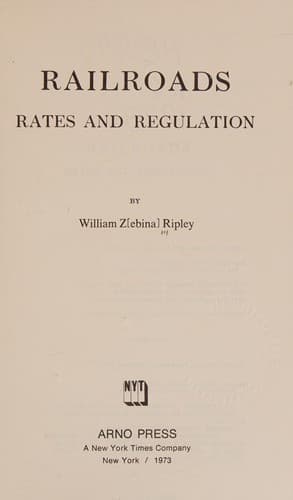
Railroads: Rates and RegulationsRipley, William Zebina
History
Railroads: Rates and Regulations
Ripley, William Zebina
Railroads -- Freight -- Rates -- United States; Railroads and state -- United States
Despite this remarkable record of growth, a corresponding development
of long-distance communication between different parts of the country
had not yet taken place. While the all-rail routes were open, they
still consisted in large part of disconnected local lines. The New
York Central with difficulty in 1853, and in spite of intense local
opposition, succeeded in effecting a consolidation of what were
originally eleven separate lines; but the union with the Hudson River
Railroad was not to follow until 1869. The Boston & Albany was still a
local enterprise, although built with larger ends in view. At this time
the possibility of long-distance carriage of grain was only very dimly
appreciated. Fast freight lines to operate without breaking bulk over
independent roads, constituted the first step in this direction. Such
companies on the New York Central in 1855 and on the Erie two years
later, were operating in the eastern trunk territory. The so-called
Green lines were engaging in long distance business by way of Ohio
river connections between the territory to the northwest and the great
grain and pork consuming cotton belt. But railroad traffic as a whole
was still relatively unimportant as compared with water carriage. The
culmination of steadily increasing receipts on the Erie Canal did not
occur until 1856. River tonnage went on steadily increasing for another
twenty years. The years just before the war seem to have marked the
turning point in respect of canal competition; but the total volume
of railroad shipments, nevertheless, still appears insignificant by
comparison with the present day. The total traffic in 1859 on the
Pennsylvania Railroad was only 353,000 tons east bound and 190,700 tons
west bound; while on the New York Central it was 570,900 and 263,400
tons, respectively. The important point was that the cost of shipment
was steadily declining. According to H. C. Carey, the passenger rate
from Chicago to New York had fallen from about seventy-five dollars to
seventeen dollars in 1850; while the freight rate per bushel on wheat
had fallen to twenty-seven cents; and per barrel of flour to eighty
cents. Nothing but the development of a large surplus production in the
West was needed to create a great traffic; and this was dependent upon
the spread of population and improvements in agricultural production
which had not yet occurred. Transportation as yet waited upon the
progress of invention; not in instruments of transportation alone, but
in all the other fields of industrial endeavor.
Public-domain text, read in full here on John Shaqi.
Reviews
Reviews
No reviews yet
Be the first to share your thoughts on this work.
Join the Discussion
Join the discussion
Sign in to leave a comment or review.
Sign InorCreate an account