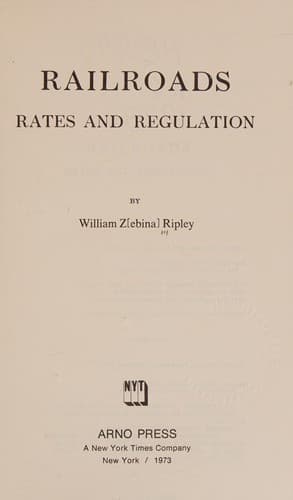
Railroads: Rates and RegulationsRipley, William Zebina
History
Railroads: Rates and Regulations
Ripley, William Zebina
Railroads -- Freight -- Rates -- United States; Railroads and state -- United States
[291] Statements taken before the Committee on Interstate Commerce of
the U. S. Senate with respect to the Transportation Interests of the
U. S. and Canada. Washington, 1890, p. 616. _Cf._ chap. X, p. 363,
_infra_; also the Wichita cases, in chap. VII, p. 232, _supra_.
[292] _Ibid._, p. 631.
[293] Senate (Elkins) Committee, 1905, II, p. 1706.
[294] Quoted from Acworth, 55th Cong., 1st sess., Sen. doc. 39, p. 33.
[295] _Newlands v. Nor. Pac. R. R. Co._; 6 Int. Com. Rep., 131.
[296] _Cf._ the case of the C. H. & D. R. R. on p. 271, _supra_.
[297] Record, Illinois Railroad Commission, concerning Reasonable
Maximum Rates, 1905, p. 165.
[298] _Cf._ p. 287, _infra_.
[299] 10 I.C.C. Rep., 29.
[300] _Boston Transcript_, Oct. 14, 1905.
[301] 8 Int. Com. Rep., 346; reprinted in our Railway Problems, chap.
XI.
[302] Senate (Elkins) Committee, 1905, IV, p. 2850.
[303] President Ramsey of the Wabash; Senate (Elkins) Committee, 1905,
III, p. 1971.
[304] Windom Committee, II, p. 796.
[305] P. 78, _supra_.
[306] Senate (Elkins) Committee, 1905, III, p. 2008.
[307] Senate (Elkins) Committee, 1905, IV, p. 3115.
[308] _Idem_, II, p. 976.
[309] Specifically described in Senate (Elkins) Committee, 1905, II, p.
923.
[310] 7 Int. Com. Rep., 458; reprinted in our Railway Problems, chap.
XII.
[311] "Practically it may be declared that the public, considered as
distinct from railway owners, must pay for all the transportation which
it receives." ... H. T. Newcomb in _Pubs. Am. Stat. Ass._, N. S. Nr.
34, p. 71.
[312] Agreements for a scale of cross freights by wholesalers' or
jobbers' associations as in Ohio for groceries or hardware are equally
effective.
[313] 7 Int. Com. Rep., 458; in our Railway Problems, chap. XII.
[314] This problem is involved in the Youngstown-Pittsburg case already
mentioned. In the original Louisville and Nashville decision the
Commission apparently preferred to encourage competition even at the
risk of its being roundabout and "illegitimate." But after the railway
attorneys expanded the "rare and peculiar" cases to cover all kinds of
competition, the Commission apparently regretted its earlier position.
_Cf._ 1 I.C.C. Rep., 82; 5 _Idem_, 389; and especially the brief of Ed.
Baxter, Esq., in the Alabama Midland case, U. S. Supreme Court, Oct.
term, 1896, No. 563, p. 118.
CHAPTER IX
FREIGHT CLASSIFICATION[315]
Public-domain text, read in full here on John Shaqi.
Reviews
Reviews
No reviews yet
Be the first to share your thoughts on this work.
Elsewhere in the archive
Join the Discussion
Join the discussion
Sign in to leave a comment or review.
Sign InorCreate an account