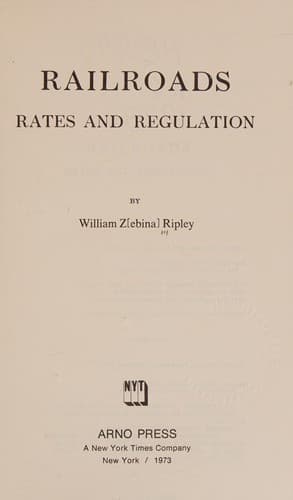
Railroads: Rates and RegulationsRipley, William Zebina
History
Railroads: Rates and Regulations
Ripley, William Zebina
Railroads -- Freight -- Rates -- United States; Railroads and state -- United States
Conditions in the West, according to these figures, are intermediate
between those in the East and the South. On the other hand,
transcontinental business, as carried on in competition with ocean
steamers, is almost entirely confined to shipment by the carload. The
Transcontinental Classification is unique, therefore, in offering but
very few opportunities for shipment by package, except under specially
onerous conditions.
The spread, in other words, between the two sorts of carriage operates
most unfavorably by contrast upon the intermountain centres. Denver,
for example, under the Western Classification enjoys no carload rates,
while competitors at San Francisco have a large number.[329]
A much more elaborate code of rules and regulations having reference to
local practices and conditions is the third accompaniment of the growth
of trade.[330] Prior to 1887, and again before the recent revival of
interest in uniform classification, conditions had become intolerable
in this regard. All sorts of details, covering relatively unimportant
differences in conditions of carriage, bill of lading contracts,
marking and packing, led to constant confusion and annoyance,
especially in cases of shipment from one classification territory to
another. An eastern shipper of iron bolts, having in mind that a gunny
sack is equivalent to a box or barrel in the East, orders a small
shipment in a bag to a far western point. He finds that bolts in bags
under the rules of the Western Classification, are specially enumerated
only for carload lots, and that he must pay a rate one class higher
for such shipment than if contained in a barrel, box or keg. This
difference in classification may more than absorb his profit. Recent
evidence before the Interstate Commerce Commission,[331] contained a
striking illustration of such local diversity in rules and descriptions
as applied to furniture.
"_Western class_: 'Bank, store, saloon and office furniture,
consisting of arm rails, back bar mirrors, bottle cases,
chairs, counter-fittings, desk, foot rails, metal brackets for
arm and foot rails, refrigerators, tables and work boards.
Note--Door, window and bar screens, partitions, prescription
cases, patent medicine cases, show cases, wall-cases,
wainscoting, office railing and wooden mantels may be shipped
with bank, store, saloon or office furniture in mixed carloads
at third-class, minimum weight 12,000 lbs.
"There is no such provision as this in the Official
Classification. On the contrary, a shipment of that kind can
only be made by figuring out the less-than-carload rate on each
article, many of which take first, double first and even three
times first ratings.
Public-domain text, read in full here on John Shaqi.
Reviews
Reviews
No reviews yet
Be the first to share your thoughts on this work.
Elsewhere in the archive
Join the Discussion
Join the discussion
Sign in to leave a comment or review.
Sign InorCreate an account