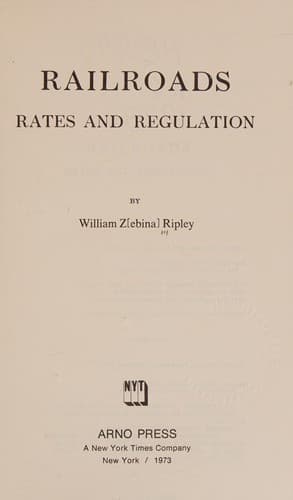
Railroads: Rates and RegulationsRipley, William Zebina
History
Railroads: Rates and Regulations
Ripley, William Zebina
Railroads -- Freight -- Rates -- United States; Railroads and state -- United States
The second natural tendency in the development of classification
above mentioned, is an increase in the number of separate ratings for
large and small shipments. The normal growth of trade ought to make
possible a steady increase in shipments by the carload, rather than by
the box, barrel, or case; and the increase in the number of separate
carload ratings--always, of course, at a reduced rate by comparison
with less-than-carload lots--conforms territorially to the growth
in the volume of trade. In 1877, even in trunk line territory, only
twenty-four commodities were accorded a special carload rate.[327] By
1880 the number had increased to 50, and seven years later to 160.
Just before the passage of the Act to Regulate Commerce there was no
distinction between carload and small lots in eighty-five per cent.
of the articles enumerated. A sudden change supervened in the first
Official Classification issued after the Federal Act. The number of
carload ratings was suddenly raised to 900, provoking a storm of
protest from eastern shippers who resented this advantage accorded to
jobbers in the West and South, because it enabled the latter to buy
their supplies directly at wholesale.
The dispute between dealers in the older and newer commercial
centres came to a head in the so-called New York Board of Trade and
Transportation case of 1888, elsewhere discussed. Yet notwithstanding
this protest of jobbers and manufacturers in eastern trade centres,
who insisted that they should be permitted to compete on even terms
with provincial jobbers by making their shipments direct from New
York or Boston in small lots as cheaply as the local jobber could buy
them by the carload, the number of separate carload ratings steadily
augmented year after year. By 1893 more than half of the articles
enumerated in the Official Classification were allowed a lower rate for
large shipments. Present conditions are set forth by the statistics
in the preceding paragraph. From these it appears that in trunk line
territory nearly three-fourths of the commodities now enjoy carload
ratings; while in the South, on the other hand, only about one-fifth
of them make such distinction between carload and less-than-carload
lots.[328] One reason is evident; namely, that throughout a large part
of the South few jobbers command a business of sufficient magnitude to
make use of carload shipments. It is but recently, to take a specific
illustration, that business has developed in volume sufficient to
permit of the shipment of fly paper in carload lots. Until such time no
distinction between large and small shipments could well be made.
Public-domain text, read in full here on John Shaqi.
Reviews
Reviews
No reviews yet
Be the first to share your thoughts on this work.
Elsewhere in the archive
Join the Discussion
Join the discussion
Sign in to leave a comment or review.
Sign InorCreate an account