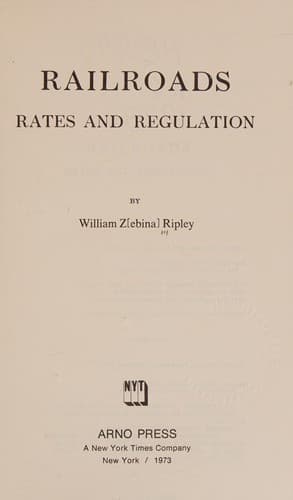
Railroads: Rates and RegulationsRipley, William Zebina
History
Railroads: Rates and Regulations
Ripley, William Zebina
Railroads -- Freight -- Rates -- United States; Railroads and state -- United States
From the point of view of economic theory, the warrant for a
differentiation of charges between various classes of commodities
offered for transportation, may be considered primarily from two
distinct points of view. The first is that of operation, which
determines cost. The second is from the standpoint of traffic whereby
the value of service, so-called, is measured. The reasonableness of
making a distinction in freight rates according to the character of
goods is easily apparent, as judged on the basis of cost of service.
A multitude of factors enter into consideration at this point. The
railway ought in self-protection to charge more for hauling a thing,
if it actually costs it more in the long run to perform that service.
Some of the factors which enter into this cost were well put by the
Interstate Commerce Commission in 1897.[334]
"Whether commodities were crude, rough, or finished; liquid
or dry; knocked down or set up; loose or in bulk; nested or
in boxes, or otherwise packed; if vegetables, whether green
or dry, desiccated or evaporated; the market value and
shippers' representations as to their character; the cost of
service, length and direction of haul; the season and manner of
shipment; the space occupied and weight; whether in carload or
less-than-carload lots; the volume of annual shipments to be
calculated on; the sort of car required, whether flat, gondola,
box, tank, or special; whether ice or heat must be furnished;
the speed of trains necessary for perishable or otherwise rush
goods; the risk of handling, either to the goods themselves
or other property; the weights, actual and estimated; the
carrier's risk or owner's release from damage or loss."
Instances of approval of classification on the basis of such cost of
operation are frequently found in the decisions of the Interstate
Commerce Commission. For example, special service or equipment, as
in the rapid transport of fresh vegetables and fruit from the South,
justify the carriers in a specially high classification.[335] Rates
on live hogs by comparison with rates on hog products, as well as on
live cattle and dressed beef, have likewise been adjusted in terms of
cost of carriage. A classification on hogs yielding a rate equal to
two-thirds of that on hog products has been held equitably to represent
the relative expense.[336] Even the indefinite element of risk has
been accepted as justifying a higher classification for live stock as
compared with other commodities.[337]
Public-domain text, read in full here on John Shaqi.
Reviews
Reviews
No reviews yet
Be the first to share your thoughts on this work.
Elsewhere in the archive
Join the Discussion
Join the discussion
Sign in to leave a comment or review.
Sign InorCreate an account