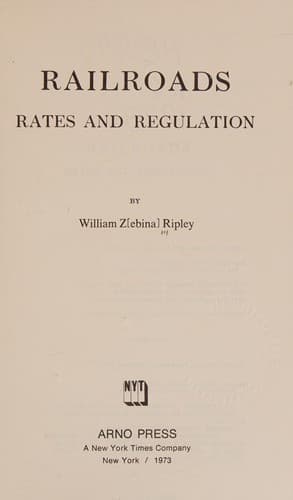
Railroads: Rates and RegulationsRipley, William Zebina
History
Railroads: Rates and Regulations
Ripley, William Zebina
Railroads -- Freight -- Rates -- United States; Railroads and state -- United States
Classification is less easy to defend from the standpoint of the
traffic manager alone, than from that of the vice-president in charge
of operation. Value of service is at times difficult to understand. It
is not at first sight reasonable, that of two commodities which cost
the railway exactly the same amount to transport, one should be charged
twice as much as the other. For example, the rate on anthracite coal
is very much higher than upon soft coal; the rate upon wheat is higher
than the rate upon some other foodstuffs; the rate upon fine woollen
goods is very much higher than upon coarse cotton cloth, etc.[338] It
has been urged frequently that any discrimination in the freight rate
on the basis of difference, either in the value of the commodity itself
or in the value of the service rendered, is unreasonable and unjust.
The case, however, is entirely analogous to that of discrimination
between a long and short haul of the same goods. The principle is
perfectly defensible in both cases, and has been accepted in legal
decisions as well as by economic writers for many years. It is based
upon the fact, which confronts one at every turn in a discussion of
railway economics, that a large proportion of the expenses of a railway
is independent of the amount of traffic. These fixed expenses must be
met at all cost if the road is to remain solvent. They constitute a
charge upon the entire traffic of the line, and are not susceptible
of apportionment to each unit of transportation. Any rate which
will contribute a surplus, small or large, above the mere cost of
transportation,--that is to say, above the expenses incident to this
particular carriage,--and which thereby lessens by the amount of that
excess the burden of the fixed charges remaining upon other traffic,
is justifiable. But it is defensible only under two conditions. The
first is that the goods at any higher rate will go by another route or
not at all; and the second is that the effect may not be detrimental
to the general course of business,--that is to say, that it is not
opposed to the public welfare. Thus a long haul at a lower rate than
the rate charged for a shorter haul, if it must be lower in order to
secure the business, constitutes no injustice to the local shipper;
for the surplus remaining above the cost of haulage of that particular
increment of freight lessens thereby the charge which must be made
upon local freight for meeting interest on bonds, maintenance of way,
and equipment expenses, etc., all of which charges, as we have seen,
go on more or less independently of the traffic. On precisely the same
grounds a discrimination of freight rates in favor of the cheaper
commodity or the less valuable service may be defended. Coal or sand
may reasonably be carried at two and one-fourth mills per ton mile,
while the road is coincidently charging three or four times as much
for hauling dry goods or fine hardware. For if a quarter of a mill
Public-domain text, read in full here on John Shaqi.
Reviews
Reviews
No reviews yet
Be the first to share your thoughts on this work.
Elsewhere in the archive
Join the Discussion
Join the discussion
Sign in to leave a comment or review.
Sign InorCreate an account