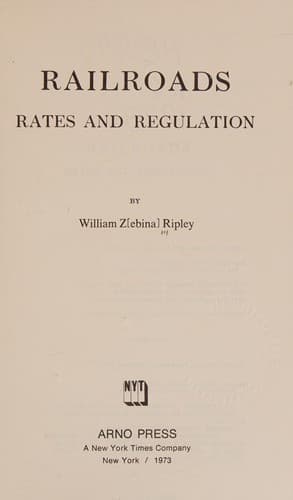
Railroads: Rates and RegulationsRipley, William Zebina
History
Railroads: Rates and Regulations
Ripley, William Zebina
Railroads -- Freight -- Rates -- United States; Railroads and state -- United States
Different classification of the same commodity according to the use
to which it may be put, is evidently an attempt to grade according
to value rather than cost of service. Automobile parts may come in
from the wheel-maker at second-class rates, but when they go out to
jobbing houses they are rated three times first class.[345] A number
of cases of this sort have come before the Commission. Shall cow peas,
for example, be classed with corn and oats as agricultural products in
one case, while according them a rating with commercial fertilizers in
another, inasmuch as they may become an active agent in nitrogenizing
soil?[346] More recently the Commission has declined to recognize the
validity of classification on this basis. Thus brick is always to be
charged the same without regard to whether it is for fire, building
or paving purposes.[347] Unusually low rates for steam coal used by
carriers and open only to certain shippers for this or other particular
purposes, likewise have been forbidden.[348] The carriers have
attempted to distinguish in grade between dried fruit and raisins. For
the two industries call for relatively different protection against
old-established competitors.[349]
As actually effected in practice, classification of freight seems
to have been largely empirical--the result of long experience in
sympathetically feeling the pulse of the business community. In the
main, despite their denial of the validity of cost as an element in
rate making, traffic managers and the Interstate Commerce Commission
seem to have been swayed more commonly by this consideration in the
make-up of schedules. Nevertheless, charging what the traffic will
bear, as a principle, will suffice alone to explain many of the details
of classification now in force. Rates have been adjusted so as to
secure the largest amount of business possible at the highest rate
compatible with that volume. In other words, traffic managers have been
mainly influenced by the consideration well stated by a witness before
the United States Industrial Commission: that, "a freight tariff is
made as it is, not because it ought to be that, but because it must
be that." The procedure of classification committees seems, in other
words, to have been mainly based upon considerations of revenue, and
that, too, without any very positive evidence as to details.[350]
Rule-of-thumb experience, therefore, is mainly represented in
classifications of the present time; that is to say, an adjustment
of freight rates upon different commodities to suit the commercial
conditions which have happened to prevail at any given time. All of
which emphasizes still further the need of scientific revision of these
most important schedules, preferably by the carriers themselves, but by
public authority if commercial inertia be too powerful to be overcome.
Public-domain text, read in full here on John Shaqi.
Reviews
Reviews
No reviews yet
Be the first to share your thoughts on this work.
Elsewhere in the archive
Join the Discussion
Join the discussion
Sign in to leave a comment or review.
Sign InorCreate an account