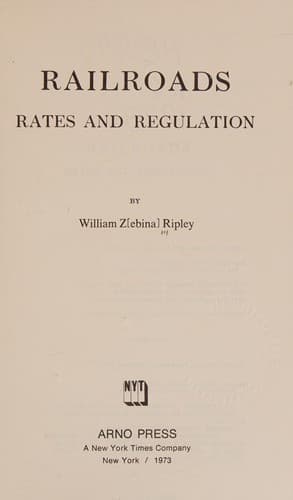
Railroads: Rates and RegulationsRipley, William Zebina
History
Railroads: Rates and Regulations
Ripley, William Zebina
Railroads -- Freight -- Rates -- United States; Railroads and state -- United States
The spread of a classification,--that is to say, the graduation of
rates as between all kinds of goods, from fine silks to lime and sand,
or from aeroplanes, "set up," to pig iron, "knocked down,"--is not
constant. How shall this be theoretically justified? At first sight
it would appear as if the relativity of charges between different
things, as determined by cost or value of service, ought to remain
fixed; that is to say, for example, that rates on raw hides fairly
standing at one-half of the charge for shoes, ought to remain always
and everywhere at this ratio. Advocates of a rigid classification
prescribed by public authority seem often to assume that this could be
brought about. But a moment's consideration of the nature of a tariff
as it has already been described will show that this is impossible. The
spread or gradation, far from being fixed, must in the nature of things
ever vary from place to place with change of trade conditions. The rate
on raw hides relatively to that on shoes in New England--the centre of
manufacture for footwear--should be very different at Kansas City or
Chicago, whence the raw hides are derived: different alone, if for no
other reason than because hides, moving east, progressively add the
cost of carriage the farther they go; while with shoes the augmentation
of value goes on in the opposite direction, geographically. True as
between commodities, the same inconstancy of ratio also holds good as
between different points along a given line. The rate from New York
to Durham, North Carolina, for example, on first-class freight may
be fifteen per cent. above that for freight of the second class; the
second class maybe twenty per cent. above that of third class for this
distance, etc.; yet the divergence between these same classes for
another distance, as between New York and Jacksonville, Florida, may
be quite different,--twenty per cent. between first and second class,
twenty-seven per cent. between second and third, and so on. This is
indeed rather a difficult matter to understand.
Public-domain text, read in full here on John Shaqi.
Reviews
Reviews
No reviews yet
Be the first to share your thoughts on this work.
Elsewhere in the archive
Join the Discussion
Join the discussion
Sign in to leave a comment or review.
Sign InorCreate an account