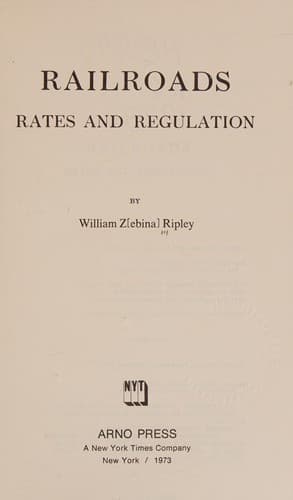
Railroads: Rates and RegulationsRipley, William Zebina
History
Railroads: Rates and Regulations
Ripley, William Zebina
Railroads -- Freight -- Rates -- United States; Railroads and state -- United States
Assuming the reasonableness of a difference in charges between carload
and small shipments, where shall the dividing line as to size be drawn?
This is the important and perplexing problem of minimum carload rates.
Turning to our excerpt from the Western Classification on page 298,
it appears that 24,000 pounds of advertising matter, N. O. S. (not
otherwise specified), must be shipped at one time in order to warrant a
carload rate. Under such circumstances a consignment of 20,000 pounds
would be classified first instead of third class--the difference in
rate varying according to distance, but in all cases being substantial.
Between St. Louis and St. Joseph, Missouri, for example, the charge
would be sixty instead of thirty-five cents per hundredweight. Were
the minimum weight for carloads but 15,000 pounds, as in the case of
harvesters under the Southern Classification, this particular shipment
of advertising matter would have enjoyed the full benefit of wholesale
charges.[365] From this instance it is apparent that the point at
which the minimum carload weight falls, is of great importance in
the determination of the actual rate--an importance also dependent,
of course, upon the spread between carload and less-than-carload
charges. It is also evident that minimum carload ratings may readily
be used as a means of advancing charges. If, as appeared in a recent
case,[366] the minimum carload for wool in sacks was advanced between
1896 and 1912 from 15,000 to 20,000 pounds, the effect upon the shipper
of a consignment of 18,000 pounds, for example, would be as truly
an increase of charges as if the freight rates themselves had been
actually advanced. For under the new schedule, he would be compelled
to pay less-than-carload charges instead of the lower carload rates
formerly granted. Moreover, it is apparent that minimum carload weights
may enter seriously into commercial competition in a number of ways.
If 45,000 pounds of raw cotton by a special round-bale process can be
loaded upon a standard car; when but 25,000 pounds of the ordinary
square bales could be carried by the same equipment; it is evident
that tariffs based upon the higher minimum would especially favor
one set of competitors as against another.[367] They might, in fact,
be sufficient to turn the scale entirely in favor of the round-bale
system throughout the South. Granted, however, that such heavy loading
makes for economy in operation, it is clear, nevertheless, that the
carload minima must be so established as not to discriminate against
the great bulk of shipments of the more common sort. All along the line
one meets with such illustrations of the bearing of the minimum carload
upon rivalry in business. Large shippers are continually striving for
a high minimum. The small shippers oppose it for the same reasons. In
a similar way the interest of the manufacturer distributing his goods
direct, in competition with middlemen, is vitally affected.[368]
Public-domain text, read in full here on John Shaqi.
Reviews
Reviews
No reviews yet
Be the first to share your thoughts on this work.
Elsewhere in the archive
Join the Discussion
Join the discussion
Sign in to leave a comment or review.
Sign InorCreate an account