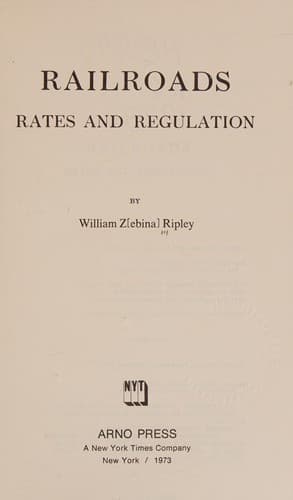
Railroads: Rates and RegulationsRipley, William Zebina
History
Railroads: Rates and Regulations
Ripley, William Zebina
Railroads -- Freight -- Rates -- United States; Railroads and state -- United States
Efforts toward uniformity were renewed in 1890,
confined this time, however, to an attempt to merge the Official and
Western Classifications. But the same jealous regard of local interests
in each territory, especially with reference to the treatment of
carload ratings, once more proved an insuperable obstacle. The trunk
lines insisted upon such specially low charges on small shipments
as would enable manufacturers and jobbers in the East to hold their
markets in remote districts in competition with rivals in the Middle
West. The issue raised in the New York Board of Trade case, previously
discussed, led to the defeat of this plan.
A notable revival of interest in uniform classification under
governmental authority has taken place since the enactment of the
Mann-Elkins amendments to the Interstate Commerce Law in 1910. An
independent bill in Congress to authorize the enforcement of such a
schedule failed. The railways were stimulated, however, to make a
further attempt to solve the difficulty.[376] Protracted sessions
during 1907-1908 by a conference of five representatives from different
parts of the country, known as the Uniform Classification Committee,
led to many concessions and compromises in favor of harmony. The
committee expressed its belief that a uniform classification could
be drawn up in time; but it emphasized the important point that
all changes in classification must be accompanied by such advances
or reductions in the distance tariffs as to insure the prevailing
commercial adjustments.
Public-domain text, read in full here on John Shaqi.
Reviews
Reviews
No reviews yet
Be the first to share your thoughts on this work.
Elsewhere in the archive
Join the Discussion
Join the discussion
Sign in to leave a comment or review.
Sign InorCreate an account