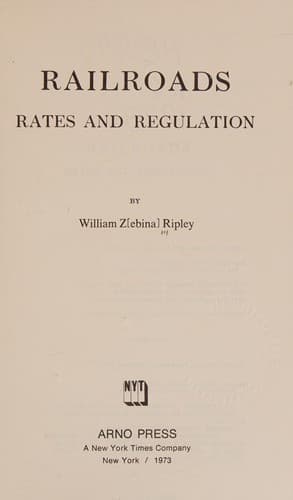
Railroads: Rates and RegulationsRipley, William Zebina
History
Railroads: Rates and Regulations
Ripley, William Zebina
Railroads -- Freight -- Rates -- United States; Railroads and state -- United States
The latest advertisement of the difficulties of uniform classification
took place in connection with the attempted introduction in 1912 of
various amendments and reforms proposed by this Uniform Classification
Committee.[377] Acting in conjunction with the National Association
of Railway Commissioners, an earnest attempt seems to have been made
to eliminate differences between the three great schedules. Few
articles were actually shifted from one class to another, the effort
being concentrated upon the establishment of more uniform rules
and descriptions. It was alleged by shippers that more often than
otherwise, these changes had brought about an advance rather than a
reduction of charges. It is difficult to decide as to this. But it is
clear that progress in the direction of uniformity is taking place.
For example, the minimum carload weight for paper, once varying greatly
in different parts of the country, was fixed at an intermediate figure
which fairly satisfied conflicting interests. Many opportunities for
personal discrimination were also eradicated. Grading according to
value, for instance, has in the past been a prolific source of abuse.
Candy at less than fifteen cents a pound rated third class, but if
of higher value moving on first-class rates, offered an incentive to
false declaration on the part of unscrupulous shippers which was very
properly eliminated. Abolition of the distinction between finished
stationery and flat paper, put an end to possible underclassification
in the same way. Naturally the carriers in abolishing such fine
distinctions, grade upward rather than downward. Much objection was
also made at this time to beneficial modification of the rules for
mixed carload shipments. Binder twine had for years been classified
with ploughs and harvesters rather than with ropes and cordage. Half
a carload of agricultural machinery, therefore, with half a carload
of twine, formerly moving under carload rates, was no longer, as
proposed, to be allowed the privilege of mixing. Similarly, abolition
of the right to bunch wood-working and iron-working machinery
naturally aroused protest. Such details are here offered, not because
of their intrinsic importance, but as illustrating the opposition on
behalf of shippers to any movement toward uniformity, even in these
minor details. What the force of this opposition would become, were
propositions advanced for shifting thousands of articles bodily from
one class to another, may be readily imagined. The experience thus far
obtained, emphasizes the point that any considerable improvement must
be carried through, if at all, by direct pressure from governmental
authority, not upon the carriers alone _but upon the shippers as well_.
Public-domain text, read in full here on John Shaqi.
Reviews
Reviews
No reviews yet
Be the first to share your thoughts on this work.
Elsewhere in the archive
Join the Discussion
Join the discussion
Sign in to leave a comment or review.
Sign InorCreate an account