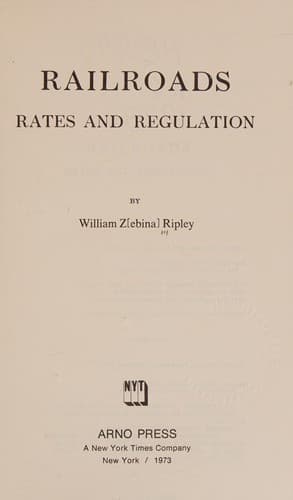
Railroads: Rates and RegulationsRipley, William Zebina
History
Railroads: Rates and Regulations
Ripley, William Zebina
Railroads -- Freight -- Rates -- United States; Railroads and state -- United States
Nor is the history of the assumption by public authority of its
inherent right to control railroads, as narrow an interest as it at
first appears. Transportation, as a service, is the commodity produced
by common carriers. The manner in which the price of this commodity has
been brought under governmental regulation has a direct bearing upon
another problem just beginning to open up; namely that of the control
by the state of the prices of other things. It is not unlikely, in my
judgment, that the final solution of the so-called Trust Problem in
the United States, whether for good or ill, may ultimately contain as
one important feature, the determination by governmental authority of
reasonable prices for such prime necessities of life as milk, ice,
coal, sugar and oil, when produced under monopolistic conditions. This
view is shared by my colleague Professor Taussig in his "Principles of
Economics." It is also distinctly set forth by President Van Hise of
the University of Wisconsin, in his recent "Concentration and Control."
When the seed of such an industrial policy is planted, as I believe
it possible in time, the soil will have been richly prepared for its
reception by our experience in the determination of reasonable charges
for the services of railroads and other public utilities.
A word of explanation may also be offered to the reader who finds
in these pages an almost exuberant mass of illustrative material.
Possibly, even, it may be alleged that in places so thick are the
circumstantial trees of evidence that one can scarcely perceive
the wood of principle. But, under the circumstances, it is almost
inevitable that this should be so. The method of inquiry adopted has
been mainly inductive. Text books and theoretical treatises have been
used only by the way. I hold them to be merely of secondary importance.
The principal reliance has been upon concrete data, painstakingly
gathered through many years from original sources. In this present
excursion in the far more complex domain of the social sciences, an
endeavor has been made to adhere strictly to the same scientific method
pursued in the field of natural science in writing "The Races of
Europe." A search far and wide for every possible bit of raw material
had to be made at the outset. To this succeeded the classification and
realignment of the concrete data thus obtained. The last step of all,
was the formulation of the governing economic principles. But an almost
indispensable result of this mode of work is a plenitude of reference
and example. One might almost say that under such circumstances it
becomes second nature to demand concrete illustration for every
economic theory or principle laid down. Such a statement, however,
would be fallacious. It would misrepresent the true sequence of events
as above outlined. Rather should it be affirmed, that, inasmuch as the
concrete examples are the sources of the reasoning, no theory can be
Public-domain text, read in full here on John Shaqi.
Reviews
Reviews
No reviews yet
Be the first to share your thoughts on this work.
Join the Discussion
Join the discussion
Sign in to leave a comment or review.
Sign InorCreate an account