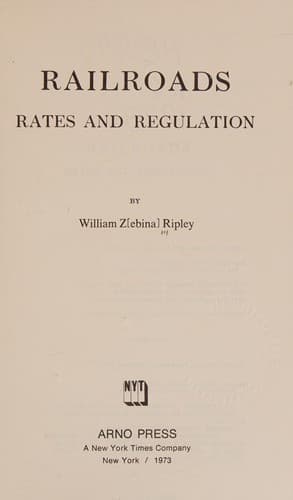
Railroads: Rates and RegulationsRipley, William Zebina
History
Railroads: Rates and Regulations
Ripley, William Zebina
Railroads -- Freight -- Rates -- United States; Railroads and state -- United States
A few general conclusions may be drawn from this rather over-elaborate
description of present conditions as to classification in the United
States. It has been necessary, however, to reiterate details in order
to make clear the extremely unsatisfactory situation at the present
time. In fact, in this domain of classification, standardization of
practice so characteristic of American rate making and operation in
general, has noticeably lagged behind. Whether it will be possible,
in view of the wide extent of the country and the diversity of its
climatic and commercial conditions, ever to devise a single uniform
classification is open to serious doubt. Even the Interstate Commerce
Commission, once a leader in the demand for uniformity, now concedes
this fact in particular instances.[386] Thus:--"wool east of the
Mississippi is taken up at numerous points and is carried under
comparatively light loading. What would be a fair classification
there, would not be just in the Far West, where the movement is almost
entirely in carloads and where the actual loading is from two to three
times that in Official Classification territory. We are of the opinion
that wool should be classified under the Western Classification as
second class, l. c. l., and fourth class, c. l.," etc. The experience
of England is, of course, commonly cited as a precedent.[387] In that
little country the ever-increasing complexity of classification was
precisely parallel to our own. From simple schedules for a few hundred
articles, the number of items steadily increased until there were over
4,000. At this point the government intervened; and after tedious and
protracted sessions under the auspices of the Board of Trade in 1888
the whole schedule was brought down to 1,400 separate items. All the
complicated and confusing rules were harmonized and many anomalies were
cut out. Certain it is that matters should be firmly taken in hand in
this country in the same manner. The separate state classifications and
hundreds of conflicting rules and jurisdictions should be eradicated.
Even if a single uniform classification be proved impracticable, as
seems to me likely, it might still be possible to greatly simplify
the present intolerable mix-up. There should be a representative of
the Interstate Commerce Commission on each of the classification
committees, ready at all times to exert pressure for simplification and
uniformity.[388] The three main classification committees, supposing
that they shall continue to exist, should interlock by exchange of
representatives. The greater the reform flowing from the initiative
of the carriers themselves, the better. Thus, in time, matters may
become sufficiently standardized as between the three main committees
so that, under legal compulsion or otherwise, the final problem of
uniformity may be tackled by recasting the whole body of tariffs and
classifications together. But such a task at this writing appears
almost superhuman.
Public-domain text, read in full here on John Shaqi.
Reviews
Reviews
No reviews yet
Be the first to share your thoughts on this work.
Elsewhere in the archive
Join the Discussion
Join the discussion
Sign in to leave a comment or review.
Sign InorCreate an account