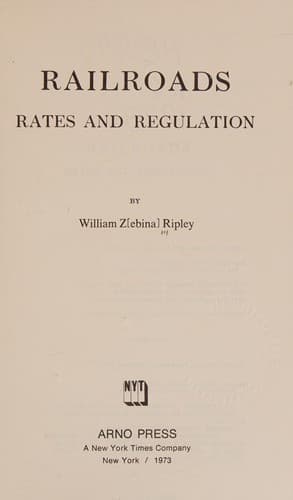
Railroads: Rates and RegulationsRipley, William Zebina
History
Railroads: Rates and Regulations
Ripley, William Zebina
Railroads -- Freight -- Rates -- United States; Railroads and state -- United States
The power and efficiency of locomotives has increased, perhaps, more
since 1890, and particularly since 1895, than in any previous period.
Superior materials particularly have contributed to this result, such
as the substitution of cast steel for cast iron and of nickel steel for
wrought iron in axles, crank pins, etc. Some of the improvements which
may be mentioned are, for instance, an increase in the average heating
surface from 2,000 in 1890 to nearly 3,000 square feet at the present
time, and an increase in the average steam pressure from 160 pounds
to 210 pounds per square inch in the same period. The maximum weight
has also increased very rapidly. The average weight of a locomotive
at the close of the Civil War was approximately 90,000 pounds. This
has increased in somewhat the following proportions: To 1881, 102,000
lbs.; to 1893, 135,000 lbs.; to 1895, 148,000 lbs.; to 1898, 230,000
lbs.; rising in 1900 to 250,000 lbs. Passenger locomotives since 1892
have almost doubled in weight, and freight engines have more than done
so. Compound and double or Mallet locomotives are also supplanting
those of simpler type for peculiarly heavy service. The first compound
engine was built in 1899, only one being constructed in that year. In
1900 a single locomotive works turned out 500--a number constituting
two-thirds of the entire output of that company--for use in the United
States. Such locomotives cost more in first instance; but the greater
weight and steam capacity, together with the considerable saving in
fuel, amounting to perhaps twenty per cent., more than offset this
objection. The traction efficiency of these improved locomotives may be
shown by the statement that in 1885 the decapod Baldwin locomotives,
made to haul 3,600 tons on a level, represented the maximum capacity.
Five years later the same company built locomotives to haul 4,000 tons,
not only on a level, but on any ordinary grade. As indicative of late
advances in locomotive construction, we may instance those built about
1900 for the Illinois Central and the Union Railroad at Pittsburg,
both low-grade roads, carrying exceedingly heavy train loads. The
first of these weighed, including its tender, 365,000 lbs., the Union
Railroad consolidation engines weighing 334,000 lbs. Such locomotives
are stated to be twice as powerful as the best which were manufactured
twenty-five years ago. This record is surpassed by engines which have
just been built for pusher service on the soft-coal Virginian Railway.
They are of the Mallet type, weighing 540,000 pounds; with a train
capacity of 4,230 tons. The evaporative surface is 6,760 square feet.
As summarizing the increased efficiency of American locomotives, we may
instance the figures of the Interstate Commerce Commission, showing
the average performance of locomotives for the United States. Whereas
in 1894 the average number of tons of freight carried per locomotive
was about 32,000 tons, this rose to 46,000 tons in 1899, and to 54,600
Public-domain text, read in full here on John Shaqi.
Reviews
Reviews
No reviews yet
Be the first to share your thoughts on this work.
Elsewhere in the archive
Join the Discussion
Join the discussion
Sign in to leave a comment or review.
Sign InorCreate an account