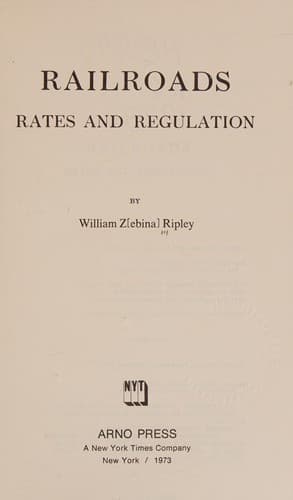
Railroads: Rates and RegulationsRipley, William Zebina
History
Railroads: Rates and Regulations
Ripley, William Zebina
Railroads -- Freight -- Rates -- United States; Railroads and state -- United States
tons in 1906. At the same time the number of tons of freight hauled one
mile for each freight locomotive in the United States increased from
4,000,000 in 1894 to approximately 6,000,000 in 1899, and to 7,300,000
in 1910. In other words, the average performance of each freight
locomotive in the United States has increased by more than fifty per
cent. in the last decade.
The economy of large freight cars has been amply demonstrated. Marked
advances in the average capacity have taken place in the last few
years. In the sixties a 15,000 pound freight car represented about
the normal capacity. This has increased, as measured by maximum load,
to 28,000 pounds in 1873; to 40,000 pounds in 1875; to 60,000 pounds
in 1885; to 70,000 pounds in 1895; while at the present time 80,000
to 100,000 pound cars are in everyday use. Cars of this latter type,
built to carry forty to fifty tons, are necessarily of pressed steel
construction, and are mainly useful for the carriage of coal and
ore and similar low-grade commodities. It seems to be questionable
whether a maximum capacity has not been about reached, in view of
the exceedingly great wear and tear imposed upon track, bridges, etc.
Up to this point the economy of heavy loading is indisputably proved.
Increased size of cars far more than proportionately increases the
paying load. Thus, for instance, an 18,000-pound car will carry 20,000
pounds load, while a 22,000-pound car will carry a load twice as great.
It is stated on good authority, for example, that a car of forty tons
capacity can be built which will weigh but 3,000 pounds more than a
thirty-ton car, and cost hardly fifty dollars more. This is undoubtedly
the reason why at the present time the average load per car is at least
one hundred per cent. greater than the maximum which was possible
twenty years ago.
Public-domain text, read in full here on John Shaqi.
Reviews
Reviews
No reviews yet
Be the first to share your thoughts on this work.
Elsewhere in the archive
Join the Discussion
Join the discussion
Sign in to leave a comment or review.
Sign InorCreate an account