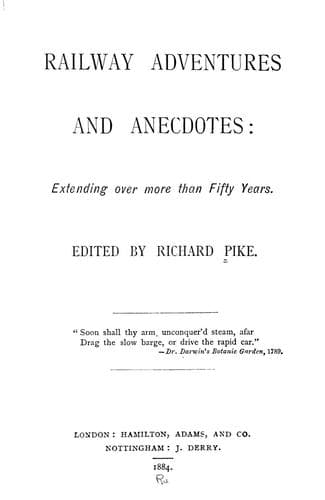
Railway Adventures and Anecdotes: Extending over More Than Fifty Years
History
Railway Adventures and Anecdotes: Extending over More Than Fifty Years
Railroads
It might naturally be thought that the new and quicker means of transport
afforded by the railway would be eagerly utilised by the Post-office.
There were, however, difficulties on both sides. The railway companies
objected to running trains during the night, and the old stage-coach
offered the advantage of greater regularity. The railway was quicker,
but was at least occasionally uncertain. Thus, in November, 1837, the
four daily mail trains between Liverpool and Birmingham on ten occasions
arrived before the specified time, on eight occasions were exact to time,
and on 102 occasions varied in lateness of arrival from five minutes to
five hours and five minutes. There were all sorts of mishaps and long
delays by train. The mail guard, like the passenger guard, rode outside
the train with a box before him called an “imperial,” which contained the
letters and papers entrusted to his charge. In very stormy weather the
mail guard would prop up the lid of his imperial and get inside for
shelter. On one occasion when the mail arrived at Liverpool the guard
was found imprisoned in his letter-box. The lid had fallen and fastened
in the male travesty of “Ginevra.” Fortunately for him it was a
burlesque and not a tragedy. Bags thrown to the guards at wayside
stations not unfrequently got under the wheels of the train and the
contents were cut to pieces. On one occasion, on the Grand Junction, an
engine failed through the fire-bars coming out. The mails were removed
from the train and run on a platelayer’s “trolly,” but unfortunately the
contents of the bags took fire and were destroyed. But many of these
mishaps were obviated by the invention of Mr. Nathaniel Worsdell, a
Liverpool coachbuilder, in the service of the railway, who took out a
patent in 1838 for an appliance for picking up and dropping mail bags
while the train was at full speed. This is still used. The loads of
railway vehicles, it may be mentioned, were limited by law to four tons
until the passage of the 5 and 6 Vic., c. 55. In 1837, when the weight
of the mails passing daily on the London and Birmingham line was only
about 14cwt., the late Sir Hardman Earle suggested that a special
compartment should be reserved for the mail guard in which he could sort
the letters _en route_. The first vehicle specially set apart for mail
purposes was put upon the Grand Junction in 1838. From this humble
beginning has gradually developed the express mails, in which the chief
consideration is the swift transit of correspondence, and which are
therefore limited in the number of the passengers they are allowed to
carry. The cost of carrying the mails in 1838 and 1839 between
Manchester and Liverpool by rail, including the guard’s fare, averaged
about £1 a trip, or half of the cost of sending them by coach. The price
paid to the Grand Junction for carriage of mails between Manchester and
Liverpool and Birmingham was 1d. a mile for the guard and ¾d. per cwt.
per mile for the mails.
Public-domain text, read in full here on John Shaqi.
Reviews
Reviews
No reviews yet
Be the first to share your thoughts on this work.
Elsewhere in the archive
Join the Discussion
Join the discussion
Sign in to leave a comment or review.
Sign InorCreate an account