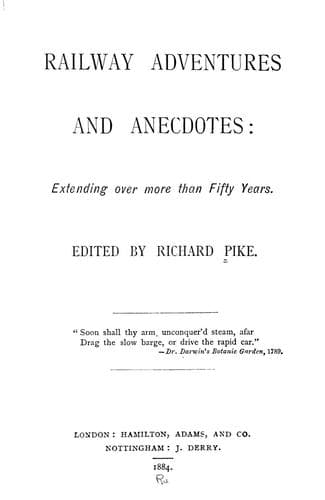
Railway Adventures and Anecdotes: Extending over More Than Fifty Years
History
Railway Adventures and Anecdotes: Extending over More Than Fifty Years
Railroads
This brought a revenue of about £3,000 a year.
When the Chancellor of the Exchequer proposed and carried the imposition
of the passenger duty, in 1832, the company intimated to the Post-office
that they should advance the mail guard’s fare ½d. per mile. In 1840 an
agreement was negotiated between the Post-office and railway authorities
to convey the mails between Lancashire and Birmingham four times daily
for £19 10s. a day, with a penalty of £500 on the railway company in case
of bad time keeping. This agreement was not carried into effect.
—_Manchester Guardian_.
RAILWAY SIGNALS.
The history of railway signals is a curious page in the annals of
practical science. For some years signals seem scarcely to have been
dreamt of. Holding up a hat or an umbrella was at first sufficient to
stop a train at an intermediate station. At level crossings the gates
had to stand closed across the line of rails, and on the top bar hung a
lamp to indicate to drivers that the way was blocked. In 1839, Colonel
Landman, of the Croydon line, said that he should avoid the danger at a
junction during a fog by going slowly, tolling a bell, beating a drum, or
sounding a whistle. The first junction signal was denominated a
lighthouse. The difficulties attending junctions may be judged of by the
fact that when the Bolton and Preston line was ready for opening it was
agreed that no train should attempt to enter or leave the North Union
line at Euxton junction within fifteen minutes of a train being due on
the main line which might interfere with it. The movable rails at
junctions had to be removed by hand and fixed into position by hammer and
pin. Mr. Watts, engineer to the Lancashire and Yorkshire Railway, is
believed to have been one of the first to use the tapering movable
switch. One of Mr. Watts’s men invented the back weight, another
designed the crank, while a third suggested the long rod. These
improvements were all about the year 1846. The first fixed signal set up
at stations was an ordinary round flag pole having a pulley on the top,
upon which was hoisted a green flag to stop a train and a red one to
indicate danger on the road. The night signal was a hand lamp hoisted in
the same way. These were superseded by a signal on which an arm was
worked at the end of a rod, and a square lamp with two sides, red and
white, having blinkers working on hinges to shut out the light. These
were used until 1848. The semaphores only came into practical use some
20 years ago, and it is remarkable that the first time they were used on
the Liverpool and Manchester line they were the cause of a slight
collision. The use of signal lights on trains was much advanced by two
accidents which occurred on the North Union line on the 7th September,
1841. One of these happened at Farrington, where two passenger trains
came into collision. The other happened at Euxton, where a coal train
Public-domain text, read in full here on John Shaqi.
Reviews
Reviews
No reviews yet
Be the first to share your thoughts on this work.
Elsewhere in the archive
Join the Discussion
Join the discussion
Sign in to leave a comment or review.
Sign InorCreate an account