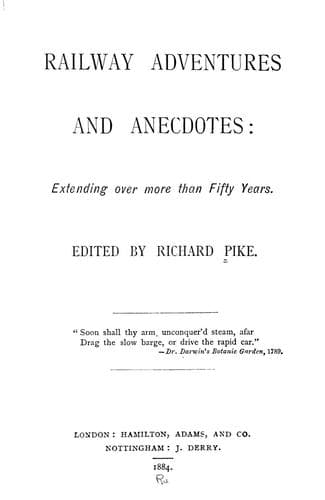
Railway Adventures and Anecdotes: Extending over More Than Fifty Years
History
Railway Adventures and Anecdotes: Extending over More Than Fifty Years
Railroads
ran into a stage coach which was taking passengers to Southport. The
Rev. Mr. Joy was killed, and several others, including the station
master, who lost one leg, were injured. These were the first serious
accidents investigated by the now Government Inspector of Railways, Sir
Frederic Smith, who was appointed by the Board of Trade under Lord
Seymour’s Act.
—_Manchester Guardian_.
FOG-SIGNALS.
During the prevalence of fogs, when neither signal-posts nor lights are
of any use, detonating signals are frequently employed, which are affixed
to the rails, and exploded by the iron tread of the advancing locomotive.
All guards, policemen, and pointsmen who are not appointed to stations,
and all enginemen, gatemen, gangers and platelayers, and tunnel-men, are
provided with packets of these signals, which they are required always to
have ready for use whilst on duty; and every engine, on passing over one
of these signals, is to be immediately stopped, and the guards are to
protect their train by sending back and placing a similar signal on the
line behind them every two hundred yards, to the distance of six hundred
yards; the train may then proceed slowly to the place of obstruction.
When these detonating signals were first invented, it was resolved to
ascertain whether they acted efficiently, and especially whether the
noise they produced was sufficient to be distinctly heard by the engine
driver. One of them was accordingly fixed to the rails on a particular
line by the authority of the company, and in due time the train having
passed over it, reached its destination. Here the engine driver and his
colleague were found to be in a state of great alarm, in consequence of a
supposed attack being made on them by an assassin, who, they said, lay
down beside the line of rails on which they had passed, and deliberately
fired at them. The efficiency of the means having thus been tested, the
apprehensions of the enginemen were removed, though there was at first
evident mortification manifested that they had been made the subjects of
such a successful experiment.
—F. S. Williams’s _Our Iron Roads_.
“ALMOST DAR NOW.”
The following anecdote, illustrative of railroad facility, is very
pointed. A traveller inquired of a negro the distance to a certain
point. “Dat ’pends on circumstances,” replied darkey. “If you gwine
afoot, it’ll take you about a day; if you gwine in de stage or homneybus,
you make it half a day; but if you get in one of _dese smoke wagons_, you
be almost dar now.”
WORDSWORTH’S PROTEST.
Lines written by Wordsworth as a protest against making a railway from
Kendal to Windermere:—
Public-domain text, read in full here on John Shaqi.
Reviews
Reviews
No reviews yet
Be the first to share your thoughts on this work.
Elsewhere in the archive
Join the Discussion
Join the discussion
Sign in to leave a comment or review.
Sign InorCreate an account