Railway Adventures and Anecdotes: Extending over More Than Fifty Years — John Shaqi
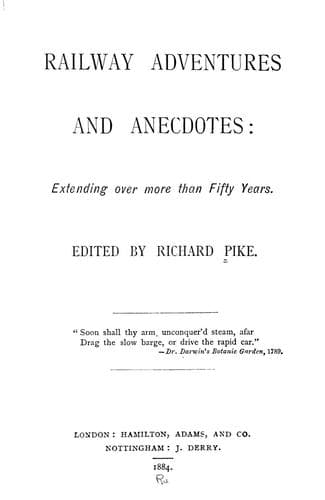
Railway Adventures and Anecdotes: Extending over More Than Fifty Years
History
Railway Adventures and Anecdotes: Extending over More Than Fifty Years
Railroads
“Sir,—Observing that it is stated in your last number (No. 1232, dated
the 20th instant, page 269), under the head of ‘Twenty-one Years’
Retrospect of the Railway System,’ that the greatest speed of
Trevithick’s engine was five miles an hour, I think it due to the memory
of that extraordinary man to declare that about the year 1808 he laid
down a circular railway in a field adjoining the New Road, near or at the
spot now forming the southern half of Euston Square; that he placed a
locomotive engine, weighing about ten tons, on that railway—on which I
rode, with my watch in hand—at the rate of twelve miles an hour; that Mr.
Trevithick then gave his opinion that it would go twenty miles an hour,
or more, on a straight railway; that the engine was exhibited at one
shilling admittance, including a ride for the few who were not too timid;
that it ran for some weeks, when a rail broke and occasioned the engine
to fly off in a tangent and overturn, the ground being very soft at the
time. Mr. Trevithick having expended all his means in erecting the works
and enclosure, and the shillings not having come in fast enough to pay
current expenses, the engine was not again set on the rail.”
SHREWD OBSERVERS.
Sir Richard Phillips was a man of foresight, for, in the year 1813, he
wrote the following words in his “Morning Walk to Kew,” a book of some
popularity in its day:—“I found delight in witnessing at Wandsworth the
economy of horse labour on the iron railway. Yet a heavy sigh escaped me
as I thought of the inconceivable millions of money which had been spent
about Malta, four or five of which might have been the means of extending
double lines of iron railway from London to Edinburgh, Glasgow, Holyhead,
Milford, Falmouth, Yarmouth, Dover, and Portsmouth. A reward of a single
thousand would have supplied coaches and other vehicles of various
degrees of speed, with the best tackle for readily turning out; and we
might ere this have witnessed our mail coaches running at the rate of ten
miles an hour, drawn by a single horse, or impelled fifteen miles an hour
by Blenkinsop’s steam engine. Such would have been a legitimate motive
for overstepping the income of a nation; and the completion of so great
and useful a work would have afforded rational ground for public triumph
in general jubilee.” Mr. Edgeworth, writing to James Watt on the 7th of
August, 1813, remarks, “I have always thought that steam would become the
universal lord, and that we should in time scorn post-horses. An iron
railroad would be a cheaper thing than a road on the common
construction.”
CUVIER’S DESCRIPTION OF THE LOCOMOTIVE.
Public-domain text, read in full here on John Shaqi.
Reviews
Reviews
No reviews yet
Be the first to share your thoughts on this work.
Join the Discussion
Join the discussion
Sign in to leave a comment or review.
Sign InorCreate an account