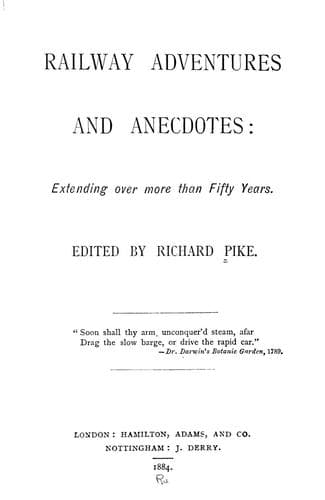
Railway Adventures and Anecdotes: Extending over More Than Fifty Years
History
Railway Adventures and Anecdotes: Extending over More Than Fifty Years
Railroads
There have been cases where claims have been made and recovered in courts
of law for loss arising from delay in the arrival of trains, but the law
does not render the company’s liability unlimited. A remarkable case
occurred not long since. A Mr. Le Blanche sued the London and
North-Western Company for the cost of a special train to Scarborough,
which he had ordered in consequence of his being brought from Liverpool
to Leeds, too late for the ordinary train from Leeds to Scarborough. A
judgment in the county court was given in favour of the applicant.
The railway company appealed to the superior court, and the points raised
were argued by able counsel, when the decision of the county court judge
was confirmed. The company was determined to put the case to the utmost
possible test, and on appealing to the Supreme Court of Judicature the
judgment was reversed, the decision being to the effect that, whilst
there was some evidence of wilful delay, the measure of damage was wrong.
—_Our Railways_, by Joseph Parsloe.
THE DYING ENGINE DRIVER.
Doubts have been expressed whether our iron ships will ever be regarded
in the same affectionate way as “liners” used to be regarded by our “old
salts.” It has been supposed that the latest creations of science will
not nourish sentiment. The following anecdote shows, however, as
romantic an attachment to iron as was ever manifested towards wood. On
the Great Western Railway, the broad gauge and the narrow gauge are
mixed; the former still existing to the delight of travellers by the
“Flying Dutchman,” whatever economical shareholders may have to say to
the contrary. The officials who have been longest on the staff also
cling to the broad gauge, like faithful royalists to a fast disappearing
dynasty. The other day an ancient guard on this line was knocked down
and run over by an engine; and though good enough medical attendance was
at hand, had skill been of any use, the dying man wished to see “the
company’s” doctor. The gentleman, a man much esteemed by all the
employés, was accordingly sent for. “I am glad you came to see me start,
doctor, (as I hope) by the up-train,” said the poor man. “I am only
sorry I can do nothing for you, my good fellow,” answered the other. “I
know that; it is all over with me. But there!—I’m glad it was _not one
of them narrow-gauge engines that did it_!”
—_Gentleman’s Magazine_.
“DOWN BRAKES,” OR FORCE OF HABIT.
An Illinois captain, lately a railroad conductor, was drilling a squad,
and while marching them by flank, turned to speak to a friend for a
moment. On looking again toward his squad, he saw they were in the act
of “butting up” against a fence. In his hurry to halt them, he cried,
“Down brakes! Down brakes!”
TRENT STATION.
Public-domain text, read in full here on John Shaqi.
Reviews
Reviews
No reviews yet
Be the first to share your thoughts on this work.
Elsewhere in the archive
Join the Discussion
Join the discussion
Sign in to leave a comment or review.
Sign InorCreate an account