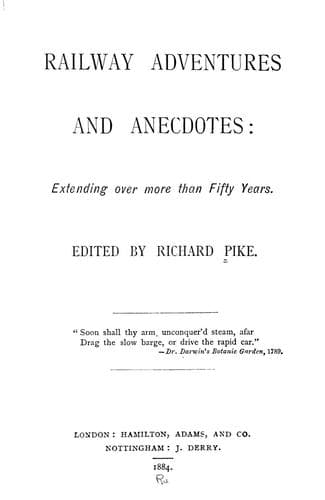
Railway Adventures and Anecdotes: Extending over More Than Fifty Years
History
Railway Adventures and Anecdotes: Extending over More Than Fifty Years
Railroads
This station on the Midland system is often a source of no little
perplexity to strangers. Sir Edward Beckett thus humorously describes
it:—“You arrive at Trent. Where that is I cannot tell. I suppose it is
somewhere near the river Trent, but then the Trent is a very long river.
You get out of your train to obtain refreshment, and having taken it, you
endeavour to find your train and your carriage. But whether it is on
this side or that, and whether it is going north or south, this way or
that way, you cannot tell. Bewildered, you frantically rush into your
carriage; the train moves off round a curve, and then you are horrified
to see some lights glaring in front of you, and you are in immediate
expectation of a collision, when your fellow-passenger calms your fears
by telling you that they are only the tail lamps of your own train.”
STEEL RAILS.
The first steel rail was made in 1857, by Mushet, at the Ebbw-Vale Iron
Co.’s works in South Wales. It was rolled from cast blooms of Bessemer
steel and laid down at Derby, England, and remained sixteen years, during
which time 250 trains and at least 250 detached engines and tenders
passed over it daily. Taking 312 working days in each year, we have the
total of 1,252,000 trains and 1,252,000 detached engines and tenders
which passed over it from the time it was first laid before it was
removed to be worked over.
The substitution of steel for iron, to an extent rendered possible by the
Bessemer process, has worked a great and abiding change in the condition
of our ways, giving greater endurance both in respect of wear and in
resistance to breaking strains and jars.
Two steel rails of twenty-one feet in length were laid on the 2nd of May,
1862, at the Chalk Farm Bridge, side by side with two ordinary rails.
After having outlasted sixteen faces of the ordinary rails, the steel
ones were taken up and examined, and it was found that at the expiration
of three years and three months, the surface was evenly worn to the
extent of only a little more than a quarter of an inch, and to all
appearance they were capable of enduring a great deal more work. The
result of this trial was to induce the London and North Western to enter
very extensively into the employment of steel rails.
_Knight’s Dictionary of Mechanics_.
CURIOUS CASUALTY.
Out of three truck loads of cattle on the Great Western Railway two of
the animals were struck dead by the lightning on Monday afternoon, July
5, 1852, not very far from Swindon. What renders it remarkable is, that
one animal only in each of the two trucks was struck, and five or six
animals in each escaped uninjured. The animal killed in one of the
trucks was a bull, the cows escaping injury, and in the other truck it
was a bull or an ox that was killed.
GEORGE STEPHENSON’S WEDDING PRESENT.
Public-domain text, read in full here on John Shaqi.
Reviews
Reviews
No reviews yet
Be the first to share your thoughts on this work.
Elsewhere in the archive
Join the Discussion
Join the discussion
Sign in to leave a comment or review.
Sign InorCreate an account