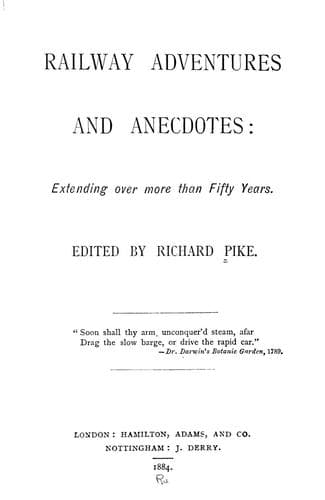
Railway Adventures and Anecdotes: Extending over More Than Fifty Years
History
Railway Adventures and Anecdotes: Extending over More Than Fifty Years
Railroads
Though the collision took place before one o’clock, in spite of the
efforts of a large gang of men who were kept throwing water on the line,
the perfect sea of flame which covered the line for a distance of some
forty or fifty yards could not be extinguished until nearly eight o’clock
in the evening, for the petroleum had flowed down into the ballasting of
the road, and the rails were red-hot. It was, therefore, small occasion
for surprise that when the fire was at last gotten under, the remains of
those who lost their lives were in some cases wholly undistinguishable,
and in others almost so. Among the thirty-three victims of the disaster,
the body of no single one retained any traces of individuality; the faces
of all were wholly destroyed, and in no case were there found feet or
legs or anything approaching to a perfect head. Ten corpses were finally
identified as those of males, and thirteen as those of females, while the
sex of ten others could not be determined. The body of one passenger,
Lord Farnham, was identified by the crest on his watch, and, indeed, no
better evidence of the wealth and social position of the victims of this
accident could have been asked for than the collection of articles found
on its site. It included diamonds of great size and singular brilliancy;
rubies, opals, emeralds; gold tops of smelling bottles, twenty-four
watches—of which but two or three were not gold—chains, clasps of bags,
and very many bundles of keys. Of these, the diamonds alone had
successfully resisted the intense heat of the flame; the settings were
nearly all destroyed.
RAILWAY DESTROYERS IN THE FRANCO-GERMAN WAR.
One obvious means of hampering the military operations of the Germans was
the cutting of railroads, so as to interrupt and overthrow on-coming
trains. This method was resorted to by bands of volunteers, calling
themselves “The Wild Boars of Ardennes,” and “Railway Destroyers.” Here
again the invaders incurred great odium by announcing that, on the
departure of a train in the disaffected districts, the mayor and
principal inhabitants should be made to take their places on the engine,
so that if the peasants chose to upset the conveyance, their surest
victims would be their own compatriots.
—_Annual Register_, 1870.
FRIGHTENED AT A RED LIGHT.
A driver, not on duty, had been drinking, and was, in company with his
fireman, walking in the vicinity of the Edgware Road, when he suddenly
started violently, and seizing his mate’s arm, shouted—
“Hold hard, mate—hold hard!”
“What’s the matter?” cried the fireman.
“Matter!” roared the driver, “why, you’re a-running by the red light;”
and he pointed to the crimson glare which streamed through a glass bottle
in a chemist’s window.
“Come along; that’s nothing,” said the fireman, trying to drag him on.
Public-domain text, read in full here on John Shaqi.
Reviews
Reviews
No reviews yet
Be the first to share your thoughts on this work.
Elsewhere in the archive
Join the Discussion
Join the discussion
Sign in to leave a comment or review.
Sign InorCreate an account