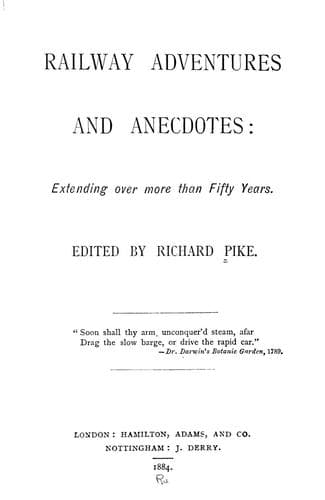
Railway Adventures and Anecdotes: Extending over More Than Fifty Years
History
Railway Adventures and Anecdotes: Extending over More Than Fifty Years
Railroads
Far otherwise was it with the finishing touch twelve years ago to the
other Transcontinental line. The whole world heard of what was then
done. All the bells in all the great cities of the United States rang
out jubilant peals as the last stroke sent home the last spike on the
last rail of the new highway of travel. The news was flashed by
telegraph everywhere throughout the Union, and that there might be no
delay in its transmission and no hindrance to its simultaneous reception,
a certain pre-arranged signal was given and all the wires were for the
time being kept free of other business. There were cases in which, to
save time in ringing out the glad news, the message was conveyed on
special wires right up to the bell towers; and everywhere there was a
feeling that a great victory had been won. Preceding the consummation,
there had been some wonderful feats in railroad construction. From the
Missouri river on the one side and from the Sacramento on the other, the
two companies—the Union Pacific and the Central Pacific—advanced against
each other in friendly rivalry. The popular idea was that the length of
the line of each company would be measured to the point at which it
joined rails with the other. This was hardly the case; but an
arrangement was come to after the completion of the work which has given
this notion the strength of a tradition. The greater part of the Union
Pacific route was over comparatively even ground, and it was not until
the Salt Lake region was being approached that any serious constructive
difficulties presented themselves. It was otherwise with the company
advancing eastward. The line had to be carried over the Sierra Nevada,
the ascent beginning almost from the starting point, and rising seven
thousand feet in a hundred miles. On the other side of the mountain
range, the descent was in turn formidable. Over this part of the road it
was impossible to proceed rapidly. The work was surrounded with
difficulties, and there were competent engineers who had no confidence
that it could be carried out. Progress could only be made at the outset
at the rate of about twenty miles each year; but in this slow work there
was time to profit by experience, so that eventually, when it became a
question simply of many hands, the platelayer went forward with the swing
of an army on the march. Then it was that the two companies went
vigorously into the race of construction. In one day, in 1868, the Union
men were able to inform the Central men by telegraph that they had laid
as many as six miles since morning. A few days afterwards the response
came from the Central men that they had just finished as their day’s work
a stretch of seven miles. Spurred to fresh activity by this display, the
Union men next reported to the other side a complete stretch for a day’s
work of seven and a half miles! The answer came back in the
extraordinary announcement that the workers for the Central Company were
Public-domain text, read in full here on John Shaqi.
Reviews
Reviews
No reviews yet
Be the first to share your thoughts on this work.
Elsewhere in the archive
Join the Discussion
Join the discussion
Sign in to leave a comment or review.
Sign InorCreate an account