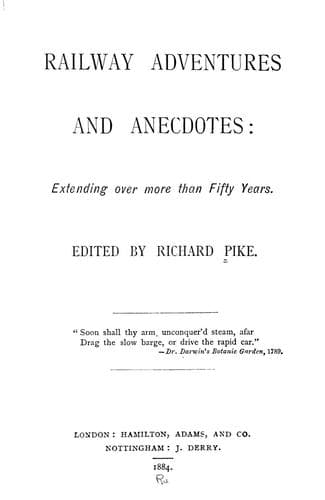
Railway Adventures and Anecdotes: Extending over More Than Fifty Years
History
Railway Adventures and Anecdotes: Extending over More Than Fifty Years
Railroads
prepared to lay ten miles in one day! The Union people were inclined to
regard this as mere boasting, and the Vice-President of the company
implied as much when he made an offer to bet ten thousand dollars that in
one day such a stretch of railroad could not be well and truly laid. It
is not on record that the bet was taken up. But the fact remains that it
was made, that the Central army of workers heard of it, and that they
determined to make good the pledge given in their name. So a day was
fixed for the attempt. From the Union side men came to take note of the
work and to measure it, and their verdict at the close of the day’s toil
was that not only had the promised ten miles been constructed, but that
the measurement showed two hundred feet over! And this, on the words of
an authority, is how it was done:—When the car loaded with rails came to
the end of the track, the two outer rails on either side were seized with
iron nippers, hauled forward off the car, and laid on the ties by four
men who attended exclusively to this work. Over these rails the cars
were pushed forward and the process repeated. Then came a gang of men
who half-drove the spikes and screwed on the fish-plates on the dropped
rails. At a short interval behind these came a gang of Chinamen, who
drove home the spikes already inserted and added the rest. A second
squad of Chinamen followed, two deep, on each side of the single track,
the inner men carrying shovels and the outer men wielding picks, their
duty being to ballast the track. Every movement was thus carefully
arranged, and there was no loss of time. The average rate of speed at
which the work was done was 1 min. 47½ secs. to every 240 feet of
perfected track. There was, of course, an army of disciplined helpers,
whose duty it was to bring up the materials. In this great feat of
construction more than four thousand men found employment in various
capacities. When they had carried their line four miles further east,
the Central and the Union men met each other, the point of connection
being known as Promontory. Afterwards the two companies made an
arrangement whereby the Union Pacific relinquished fifty-three miles of
road to the Central, thus fixing on Ogden as the western terminus of the
one line and the eastern terminus of the other. The popular belief is
that the fifty-three miles were obtained by the Central Pacific directors
as an acknowledgement of the greater engineering difficulties they had to
overcome in laying their part of the track, and that they served a
handicapping purpose at the end of this wonderful railroad competition.
Public-domain text, read in full here on John Shaqi.
Reviews
Reviews
No reviews yet
Be the first to share your thoughts on this work.
Elsewhere in the archive
Join the Discussion
Join the discussion
Sign in to leave a comment or review.
Sign InorCreate an account