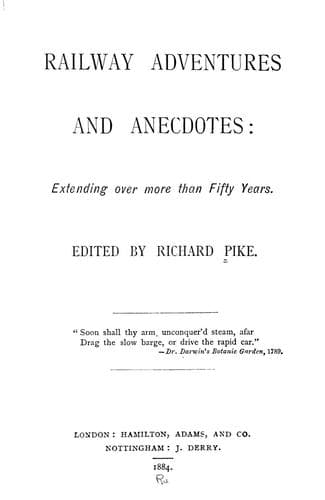
Railway Adventures and Anecdotes: Extending over More Than Fifty Years
History
Railway Adventures and Anecdotes: Extending over More Than Fifty Years
Railroads
It is stated in the year 1825, there was in the whole world, only one
railway carriage, built to convey passengers. It was on the first
railway between Stockton and Darlington, and bore on its panels the
motto—“Periculum privatum, publica utilitas.” At the opening of this
line the people’s ideas of railway speed were scarcely ahead of the canal
boat. For we are told, “Strange to say, a man on horseback carrying a
flag headed the procession. It was not thought so dangerous a place
after all. The locomotive was only supposed to go at the rate of from
four to six miles an hour; an ordinary horse could easily keep ahead of
that. A great concourse of people stood along the line. Many of them
tried to accompany the procession by running, and some gentlemen on
horseback galloped across the fields to keep up with the engine. At a
favourable part of the road Stephenson determined to try the speed of the
engine, and he called upon the horseman with the flag to get out of his
way! The speed was at once raised to twelve miles an hour, and soon
after to fifteen, causing much excitement among the passengers.”
George Stephenson was greatly impressed with the vast possibilities
belonging to the future of railway travelling. When battling for the
locomotive he seemed to see with true prescience what it was destined to
accomplish. “I will do something in course of time,” he said, “which
will astonish all England.” Years afterwards when asked to what he
alluded, he replied, “I meant to make the mail run between London and
Edinburgh by the locomotive before I died, and I have done it.” Thus was
a similar prediction fulfilled, which at the time he uttered it was
doubtless considered a very wild prophecy, “Men shall take supper in
London and breakfast in Edinburgh.”
From a small beginning railways have spread over the four quarters of the
globe. Thousands of millions of pounds have been spent upon their
construction. Railway contractors such as Peto and Brassey at one time
employed armies of workmen, more numerous than the contending hosts
engaged in many a battle celebrated in history. Considering the mighty
revolutions that have been wrought in social affairs and in the commerce
of the world by railways, John Bright was not far wrong when he said in
the House of Commons “Who are the greatest men of the present age? Not
your warriors, not your statesmen. They are your engineers.”
Public-domain text, read in full here on John Shaqi.
Reviews
Reviews
No reviews yet
Be the first to share your thoughts on this work.
Join the Discussion
Join the discussion
Sign in to leave a comment or review.
Sign InorCreate an account