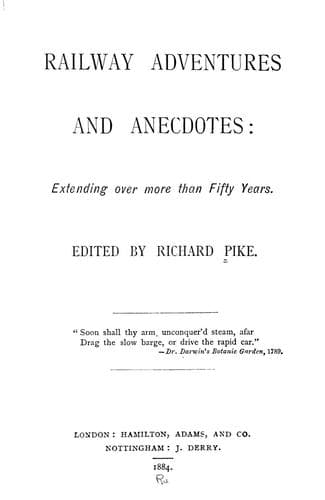
Railway Adventures and Anecdotes: Extending over More Than Fifty Years
History
Railway Adventures and Anecdotes: Extending over More Than Fifty Years
Railroads
The _Indianapolis News_ is responsible for the following story. A
railroad official of Indianapolis had, among other passes, one purporting
to carry him freely over the Warren and Tonawanda Narrow-Gauge Railway.
Happening to be near Warren, he thought he would use this pass. Now, it
appears that some enterprising citizens of Pennsylvania once proposed to
lay a pipe-line for petroleum between Warren and Tonawanda. The
Legislature having refused to sanction their scheme, they “engineered” a
bill for building a narrow-gauge line, which passed, the oil capitalists
not conceiving that they had any interest in opposing it. It is needless
to say the narrow-gauge line was the “desiderated pipe-line.” The
enterprising citizens carried their joke so far as to issue annual passes
over the road, receiving others in return. When the traveller sought for
the Warren station on this line he found a chimney, and for the
narrow-gauge an iron-lined hole in the ground. It is hardly surprising
that now he is moved to anger at the slightest reference to the “Warren
and Tonawanda Narrow Gauge.”
AT FAULT.
It is rather a serious matter that our public companies, and especially
our railway companies, are doing their best to degrade our language. I
am not going to be squeamish and object strongly to the use of the word
_Metropolitan_, though I think it indefensible. Still, it is too bad of
them to persist in using the word _bye-laws_ for _by-laws_—so
establishing solidly a shocking error. The word _bye_ has no existence
in England except as short for _be with you_, in the phrase _Good-bye_.
The so called by-laws are simple laws by the other laws, and have nothing
to do with any form of salutation. In a bill of the Great Western
Railway I find the announcement that tickets obtained in London on any
day from December 20th to 24th will be available for use on _either_ of
those days—this _either_ meaning the five days from the 20th December to
the 24th inclusive. Either of five! After this I am not surprised that,
in a contribution of my own to a daily paper, the editor gravely altered
the phrase _the last-named_, applied to one of three people, to _latter_.
In a railway advertisement I read a day or two ago, “From whence.” Now,
what is the good of such fine words as _whence_ and _thence_ if they are
thus to be ill-used? Surely the railway companies might have some one
capable of seeing that their grammar has some pretence to correctness.
—_Gentleman’s Magazine_.
A WIDOW’S CLAIM FOR COMPENSATION.
Public-domain text, read in full here on John Shaqi.
Reviews
Reviews
No reviews yet
Be the first to share your thoughts on this work.
Elsewhere in the archive
Join the Discussion
Join the discussion
Sign in to leave a comment or review.
Sign InorCreate an account