Railway Adventures and Anecdotes: Extending over More Than Fifty Years — John Shaqi
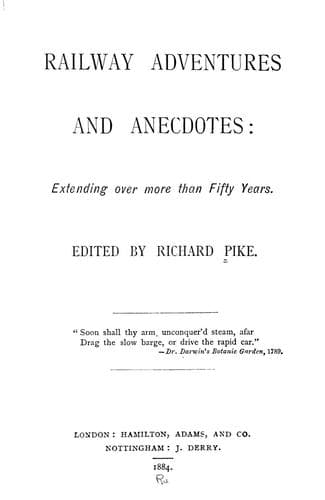
Railway Adventures and Anecdotes: Extending over More Than Fifty Years
History
Railway Adventures and Anecdotes: Extending over More Than Fifty Years
Railroads
The first Stockton and Darlington Act gave permission to all parties to
use the line on payment of certain rates. Thus private individuals might
work their own horses and carriages upon the railway and be their own
carriers. Mr. Clepham, in the _Gateshead Observer_, gives an interesting
account of the competition induced by the system:—“There were two
separate coach companies in Stockton, and amusing collisions sometimes
occurred between the drivers—who found on the rail a novel element for
contention. Coaches cannot pass each other on the rail as on the road;
and at the more westward public-house in Stockton (the Bay Horse, kept by
Joe Buckton), the coach was always on the line betimes, reducing its
eastward rival to the necessity of waiting patiently (or impatiently) in
the rear. The line was single, with four sidings in the mile; and when
two coaches met, or two trains, or coach and train, the question arose
which of the drivers must go back? This was not always settled in
silence. As to trains, it came to be a sort of understanding that light
wagons should give way to loaded; as to trains and coaches, that the
passengers should have preference over coals; while coaches, when they
met, must quarrel it out. At length, midway between sidings a post was
erected, and a rule was laid down that he who had passed the pillar must
go on, and the coming man go back. At the Goose Pool and Early Nook, it
was common for these coaches to stop; and there, as Jonathan would say,
passengers and coachmen ‘liquored.’ One coach, introduced by an
innkeeper, was a compound of two mourning coaches, an approximation to
the real railway coach, which still adheres, with multiplying exceptions,
to the stage coach type. One Dixon, who drove the ‘Experiment’ between
Darlington and Shildon, is the inventor of carriage lighting on the rail.
On a dark winter night, having compassion on his passengers, he would buy
a penny candle, and place it lighted amongst them, on the table of the
‘Experiment’—the first railway coach (which, by the way, ended its days
at Shildon, as a railway cabin), being also the first coach on the rail
(first, second, and third class jammed all into one) that indulged its
customers with light in darkness.”
CALCULATION AS TO RAILWAY SPEED.
The Editor of _The Scotsman_, having engaged in researches into the laws
of friction established by Vince and Coloumb, published the results in a
series of articles in his journal in 1824 showing how twenty miles an
hour was, on theoretic grounds, within the limits of possibility; and it
was to his writings on this point that Mr. Nicholas Wood alluded when he
spoke of the ridiculous expectation that engines would ever travel at the
rate of twenty, or even twelve miles an hour.
ALARMIST VIEWS.
Public-domain text, read in full here on John Shaqi.
Reviews
Reviews
No reviews yet
Be the first to share your thoughts on this work.
Join the Discussion
Join the discussion
Sign in to leave a comment or review.
Sign InorCreate an account