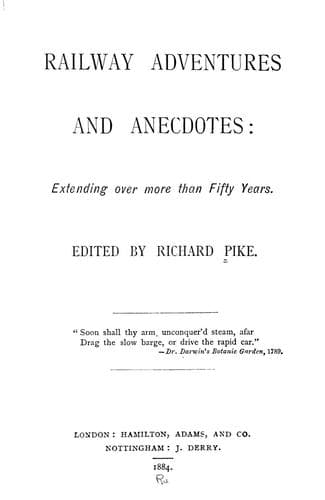
Railway Adventures and Anecdotes: Extending over More Than Fifty Years
History
Railway Adventures and Anecdotes: Extending over More Than Fifty Years
Railroads
Max. O’Rell, the French author, in his book _John Bull at Home_, writes
English people are very great on words; lying is unknown. I was
travelling by rail one day with an English bishop. There were five in
our compartment. On arriving at a station we heard a cry, “Five minutes
here!” My lord bishop, with the greatest haste, set to work to spread
out travelling-bag, hat-box, rug, papers, &c. A lady appeared at the
door, and asked, “Is there room here?” “Madam,” replied the bishop, “all
the seats are full.” When the poor lady had been sent about her
business, we called his lordship’s attention to the fact that there were
only five of us in the carriage, and that, consequently all the seats
were not taken. “I did not say that they were,” answered my lord; “I
said that they were _full_.”
DROPPING THE LETTER “L.”
In an advertisement by a railway company of some unclaimed goods, the “l”
dropped from the word “lawful,” and it reads now, “People to whom these
packages are directed are requested to come forward and pay the _awful_
charges on the same.”
THE SAFEST SEAT IN A RAILWAY CARRIAGE.
The _American Engineer_, as the result of scientific calculations and
protracted experience, says the safest seat is in the middle of the last
car but one. There are some chances of danger, which are the same
everywhere in the train, but others are least at the above-named place.
RAILWAYS A JUDGMENT.
In _White’s Warfare of Science_ there is an account of a worthy French
Archbishop who declared that railways were an evidence of the divine
displeasure against innkeepers, inasmuch that they would be punished for
supplying meat on fast days by seeing travellers carried by them past
their doors.
CLAIM FOR GOODWILL FOR COW KILLED ON THE RAILWAY.
A farmer living near the New York Central lost a cow by a collision with
a train on the line; anxious for compensation he waited upon the manager
and after stating his case, the manager said, “I understand she was thin
and sick.” “Makes no difference,” replied the farmer. “She was a cow,
and I want pay for her.” “How much?” asked the manager. “Two hundred
dollars!” replied the farmer. “Now look here,” said the manager, “how
much did the cow weigh?” “About four hundred, I suppose,” said the
farmer. “And we will say that beef is worth ten cents a pound on the
hoof.” “It’s worth a heap more than that on the cow-catcher!” replied
the indignant farmer. “But we’ll call it that, what then? That makes
forty dollars, shall I give you a cheque for forty dollars?” “I tell you
I want two hundred dollars,” persisted the farmer. “But how do you make
the difference? I’m willing to pay full value, forty dollars. How do
you make one hundred and sixty dollars?” “Well, sir,” replied the
farmer, waxing wroth, “I want this railroad to understand that I’m going
to have something special for the goodwill of that cow!”
THE INSURANCE AGENT.
Public-domain text, read in full here on John Shaqi.
Reviews
Reviews
No reviews yet
Be the first to share your thoughts on this work.
Elsewhere in the archive
Join the Discussion
Join the discussion
Sign in to leave a comment or review.
Sign InorCreate an account