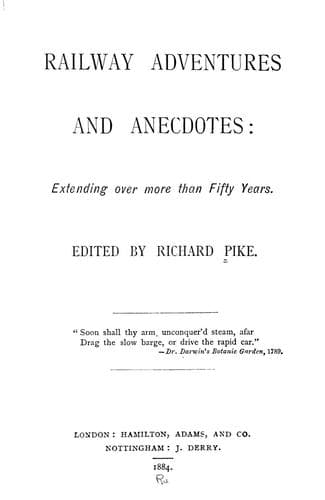
Railway Adventures and Anecdotes: Extending over More Than Fifty Years
History
Railway Adventures and Anecdotes: Extending over More Than Fifty Years
Railroads
for his ticket I think—I
forget the exact amount. Our counsel, the Attorney-General, went into
the thing, with the very able assistance of Mr. Willis, who deserves
every possible credit. We also had Mr. Le Gros Clarke, the eminent
consulting surgeon of the company, and Dr. Arkwright from the north of
England, and they told us that in their opinion it was a swindle. And it
was a swindle. The result of it was, the Attorney-General put his foot
down upon it, and declared that it was a swindle, and the jury
unanimously non-suited Mr. Roper. Well, singularly enough, when I say he
had paid 4d., I think it was not absolutely proved that he was in the
train at all. But although this was a case in which the jury said there
was no case, and where the Judge summed up strongly that it was a fraud,
and where the most eminent surgeon said it was an absolute delusion
altogether, and where, in point of fact, justice was done entirely to you
as regards the verdict, you have £2,300 to pay for costs of one kind or
another in defending a case of swindling, because when you try to recover
the costs the man becomes bankrupt, and you won’t get a farthing; and I
do mean to say I have described a state of the law and practice that
ought to excite the reprobation of every honest man in England.”
HEROISM OF A DRIVER.
An engine-driver on the Pennsylvania Railway yesterday saved the lives of
600 passengers by an extraordinary act of heroism. The furnace door was
opened by the fireman to replenish the fire while the train was going at
thirty-five miles an hour. The back draught forced the flames out so
that the car of the locomotive caught fire, and the engine-driver and the
fireman were driven back over the tender into the passenger car, leaving
the engine without control. The speed increased, and the volume of flame
with it. There was imminent danger that all the carriages would take
fire, and the whole be consumed. The passengers were panic-stricken. To
jump off was certain death; to remain was to be burned alive. The
engine-driver saw that the only way to save the passengers was to return
to the engine and stop the train. He plunged into the flames, climbed
back over the tender, and reversed the engine. When the train came to a
standstill, he was found in the water-tank, whither he had climbed, with
his clothes entirely burnt off, his face disfigured, his hands shockingly
burned, and his body blistered so badly that the flesh was stripped off
in many places. Weak and half-conscious he was taken to the hospital,
where his injuries were pronounced serious, with slight chance of
recovery. As soon as the train stopped the flames were easily
extinguished. The unanimous testimony of the passengers is that the
engine-driver saved their lives. His name is Joseph A. Sieg.
—_Daily News_, Oct. 24th, 1882.
IT’S CROYDON.
Public-domain text, read in full here on John Shaqi.
Reviews
Reviews
No reviews yet
Be the first to share your thoughts on this work.
Elsewhere in the archive
Join the Discussion
Join the discussion
Sign in to leave a comment or review.
Sign InorCreate an account