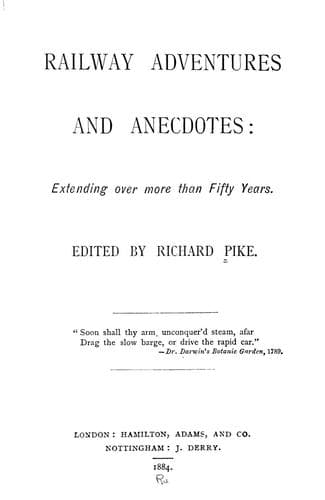
Railway Adventures and Anecdotes: Extending over More Than Fifty Years
History
Railway Adventures and Anecdotes: Extending over More Than Fifty Years
Railroads
At the present day it is amusing to read the speeches of the counsel
employed against an act of Parliament being passed in favour of the
railway between Liverpool and Manchester. Mr. Harrison, who appeared on
behalf of certain landowners against the scheme, thus spoke with regard
to the powers of the locomotive engine:—“When we set out with the
original prospectus—I am sorry I have not got the paper with me—we were
to gallop, I know not at what rate, I believe it was at the rate of
twelve miles an hour. My learned friend, Mr. Adam, contemplated,
possibly in alluding to Ireland, that some of the Irish members would
arrive in wagons to a division. My learned friend says, that they would
go at the rate of twelve miles an hour, with the aid of a devil in the
form of a locomotive, sitting as a postillion upon the fore-horse, and an
Honourable Member, whom I do not see here, sitting behind him to stir up
the fire, and to keep it up at full speed. But the speed at which these
locomotive engines are to go has slackened; Mr. Adam does not now go
faster than five miles per hour. The learned Sergeant says, he should
like to have seven, but he would be content to go six. I will show you
he cannot go six; and probably, for any practical purposes, I may be able
to show, that I can keep up with him by the canal. Now the real evidence
to which you alone can pay attention shows, that practically, and for
useful purposes, upon the average, and to keep up the rate of speed
continually, they may go at something more than four miles an hour. In
one of the collieries, there is a small engine with wheels four feet in
diameter, which, with moderate weights has gone six; but I will not
admit, because, in an experiment or two, they may have been driven at the
rate of seven or eight miles an hour—because a small engine has been
driven at the rate of six, that this is the average rate at which they
can carry goods upon a railroad for the purpose of commerce, for that is
the point to which the Committee ought to direct their attention, and to
which the evidence is to be applied. It is quite idle to suppose, that
an experiment made to ascertain the speed, when the power is worked up to
the greatest extent, can afford a fair criterion of that which an engine
will do in all states of the weather. In the first place, locomotive
engines are liable to be operated upon by the weather. You are told that
they are affected by rain, and an attempt has been made to cover them;
but the wind will affect them, and any gale of wind which would affect
the traffic on the Mersey, would render it impossible to set off a
locomotive engine, either by poking up the fire, or keeping up the
pressure of the steam till the boiler is ready to burst. I say so, for a
scientific person happened to see a locomotive engine coming down an
inclined plane, with a tolerable weight behind it, and he found that the
strokes were reduced from fifty to twelve, as soon as the wind acted upon
Public-domain text, read in full here on John Shaqi.
Reviews
Reviews
No reviews yet
Be the first to share your thoughts on this work.
Join the Discussion
Join the discussion
Sign in to leave a comment or review.
Sign InorCreate an account