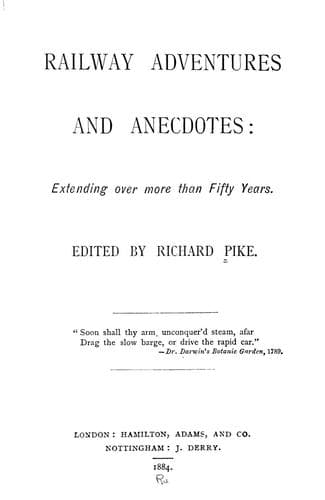
Railway Adventures and Anecdotes: Extending over More Than Fifty Years
History
Railway Adventures and Anecdotes: Extending over More Than Fifty Years
Railroads
“The causes of greater danger on the railway are several. A velocity of
fifteen miles an hour is in itself a great source of danger, as the
smallest obstacle might produce the most serious consequences. If, at
that rate, the engine or any forward part of the train should suddenly
stop, the whole would be cracked by the collision like nutshells. At all
turnings there is a danger that the latter part of the train may swing
off the rails; and, if that takes place, the most serious consequences
must ensue before the whole train can be stopped. The line, too, upon
which the train must be steered admits of little lateral deviation, while
a stage coach has a choice of the whole roadway. Independently of the
velocity, which in coaches is the chief source of danger, there are many
perils on the railway, the rails stand up like so many thick knives, and
any one alighting on them would have but a slight chance of his life . .
. Another consideration which would deter travellers, more especially
invalids, ladies, and children, from making use of the railways, would be
want of accommodation along the line, unless the directors of the railway
choose to build inns as commodious as those on the present line of road.
But those inns the directors would have in part to support also, because
they would be out of the way of any business except that arising from the
railway, and that would be so trifling and so accidental that the
landlords could not afford to keep either a cellar or a larder.
“Commercial travellers, who stop and do business in all the towns and by
so doing render commerce much cheaper than it otherwise would be, and who
give that constant support to the houses of entertainment which makes
them able to supply the occasional traveller well and at a cheap rate,
would, as a matter of course, never by any chance go by the railroad; and
the occasional traveller, who went the same route for pleasure, would go
by the coach road also, because of the cheerful company and comfortable
dinner. Not one of the nobility, the gentry, or those who travel in
their own carriages, would by any chance go by the railway. A nobleman
would really not like to be drawn at the tail of a train of wagons, in
which some hundreds of bars of iron were jingling with a noise that would
drown all the bells of the district, and in the momentary apprehension of
having his vehicle broke to pieces, and himself killed or crippled by the
collision of those thirty-ton masses.”
SIR ASTLEY COOPER’S OPPOSITION TO THE LONDON AND BIRMINGHAM RAILWAY.
Public-domain text, read in full here on John Shaqi.
Reviews
Reviews
No reviews yet
Be the first to share your thoughts on this work.
Elsewhere in the archive
Join the Discussion
Join the discussion
Sign in to leave a comment or review.
Sign InorCreate an account