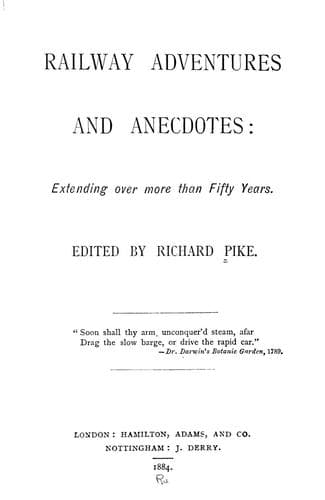
Railway Adventures and Anecdotes: Extending over More Than Fifty Years
History
Railway Adventures and Anecdotes: Extending over More Than Fifty Years
Railroads
“In 1845, a bill for a line now existing went before Parliament with
eighteen competitors, each party relying on the wisdom of Parliament to
allow their bill at least to pass a second reading! Nineteen different
parties condemned to one scene of contentious litigation! They each and
all had to pay not only the costs of promoting their own line, but also
the costs of opposing eighteen other bills. And yet conscious as
government must have been of this fact, Parliament deliberately abandoned
the only step it ever took on any occasion of subjecting railway projects
to investigation by a preliminary tribunal. Parliamentary committees
generally satisfied themselves with looking on and watching the ruinous
game of competition for which the public are ultimately to pay. In fact,
railway legislation became a mere scramble, conducted on no system or
principle. Schemes of sound character were allowed to be defeated on
merely technical grounds, and others of very inferior character were
sanctioned by public act, after enormous Parliamentary expenses had been
incurred. Competing lines were granted, sometimes parallel lines through
the same district, and between the same towns.”
AN EXPENSIVE PARLIAMENTARY BILL.
A writer in the _Popular Encyclopædia_ observes:—“But the most
conspicuous example in recent times, which overshadowed all others, of
excessive expenditure in Parliamentary litigation as well as in land and
compensation, is supplied in the history of the Great Northern Company.
The preliminary expenses of surveys, notices to landowners, etc.,
commenced in 1844, and the Bill was introduced into the House of Commons
in 1845, when it was opposed by the London and North-Western, the Eastern
Counties, and the Midland Railways. It was further opposed successively
by two other schemes, called the London and York and the Direct Northern.
The contest lasted eighty-two days before the House of Commons, more than
half the time having been consumed by opposition to the Bill. The Bill
was allowed to stand over till next year (1846), when it began, before
the Committee of the House of Lords, where it left off in the Lower House
in the year 1845 on account of the magnitude of the case. The Bill was
before the Upper House between three and four weeks, and in the same year
(1846) it was granted. The promoters of the rival projects were bought
off, and all their expenses paid, including the costs of the opposition
of the neighbouring lines already named, before the Great Northern bill
was passed; and the ‘preliminary expenses,’ comprising the whole
expenditure of every kind up to the passing of the bill was £590,355, or
more than half-a-million sterling, incurred at the end of two years of
litigation. Subsequently to the passing of the Act an additional sum of
£172,722 was expended for law engineering expenses in Parliament to 31st
December, 1857, which was spent almost wholly in obtaining leave from
Parliament to make various alterations.
Public-domain text, read in full here on John Shaqi.
Reviews
Reviews
No reviews yet
Be the first to share your thoughts on this work.
Elsewhere in the archive
Join the Discussion
Join the discussion
Sign in to leave a comment or review.
Sign InorCreate an account