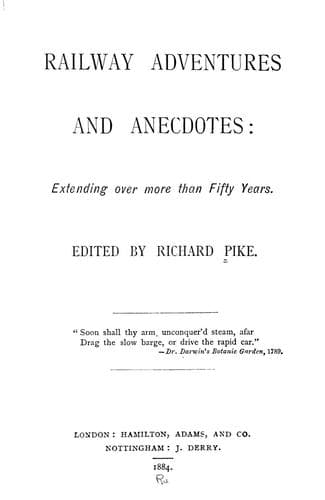
Railway Adventures and Anecdotes: Extending over More Than Fifty Years
History
Railway Adventures and Anecdotes: Extending over More Than Fifty Years
Railroads
Mr., afterwards Sir S. Morton Peto, having undertaken the construction of
certain railways in East Anglia, was at this time in the habit of
spending a considerable part of the year in the neighbourhood of Norwich,
and, with his family, joined Mr. Brock’s congregation. It will
afterwards appear how many important movements turned upon the friendship
which was thus formed; but it is only now to be noted that, in the course
of frequent conversations, the practicability was discussed of attempting
something which might serve to interest and improve the large number of
labourers employed on the works in progress. They were part of that
peculiar body of men which had been gradually formed during a long course
of years for employment in the construction, first of navigable canals,
and then of railways, and called, from their earlier occupation,
“navvies.” They were drawn from diverse parts of the British Islands,
and professed, in some instances, hostile forms of religion, but were
distinguished chiefly by extreme ignorance and all but total spiritual
insensibility. They had, at the same time, a common life and an
unwritten law, affecting their relations to each other, their employers,
and the rest of the world. That they were accessible to kind
attentions—clearly disinterested—followed from their being men, but they
required to be approached with the greatest caution and patience. Mr.
Brock’s wide and various sympathy, joined with his friend’s steady
support, led—under the divine blessing—to measures which proved very
successful. Mr. Peto constructed commodious halls capable of being moved
onward as the line of railway advanced, and affording comfortable shelter
for the men in their leisure hours, and furnished with books and
publications supplying amusement, useful information, and religious
knowledge. To give life to this apparatus, Christian men, carefully
selected, mingled familiarly with the rude but grateful toilers, helping
them to read and write, encouraging them to acquire self-command, and
above all, especially when they were convened on Sundays, presenting and
pressing home upon them the words of eternal life.
Mr. Brock had liberty to draw on the “Railway Mission Account,” at the
Norwich Bank, to any extent that he found necessary, and in a short time
he had a body of the best men, he was accustomed to say, that he ever
knew at work upon all the chief points of the lines. No part of his now
extended labours gave him greater delight than in superintending these
missionaries, reading their weekly journals, arranging their periodical
movements, counselling and comforting them in their difficulties, and
visiting them, sometimes apart and at other times at conferences for
united consultation and prayer, held at Yarmouth, Ely, or March.
Results of the best character, of which the record is on high, arose out
of these operations.
—Birrell’s _Life of the Rev. W. Brock_, _D.D._
CLEVER CAPTURE.
Public-domain text, read in full here on John Shaqi.
Reviews
Reviews
No reviews yet
Be the first to share your thoughts on this work.
Elsewhere in the archive
Join the Discussion
Join the discussion
Sign in to leave a comment or review.
Sign InorCreate an account