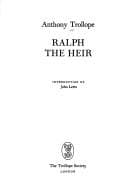
Domestic fiction; England -- Fiction; Fathers and sons -- Fiction; Inheritance and succession -- Fiction
"Oh, Clary!"
"I was. I told Patience how it was to be. I saw it in his eyes. One
does see these things. I knew it would be so; and I told Patience
that we three would be three Mrs. Newtons. But that of course was
nonsense."
"Nonsense, indeed."
"I mean about Patience."
"And what about yourself, Clary?" Clarissa made no answer, and yet
she was burning to tell her own story. She was most anxious to tell
her own story, but only on the condition of reciprocal confidence.
The very nature of her story required that the confidence should be
reciprocal. "You said that you wanted to tell me everything," said
Mary.
"And so I do."
"You know how glad I shall be to hear."
"That is all very well, but,--" And then Clarissa paused.
"But what, dear?"
"You do mean to accept Mr. Newton?"
Now it was time for Mary to pause. "If I were to tell you my whole
heart," she said, "I should be ashamed of what I was saying; and yet
I do not know that there is any cause for shame."
"There can be none," said Clary. "I am sure of that."
"My acquaintance with Mr. Newton is very, very slight. I liked
him,--oh, so much. I thought him to be high-spirited, manly, and a
fine gentleman. I never saw any man who so much impressed me."
"Of course not," said Clarissa, making a gesture as though she
would stop on the high road and clasp her hands together, in which,
however, she was impeded by her parasol and her remembrance of her
present position.
"But it is so much to say that one will love a man better than all
the world, and go to him, and belong to him, and be his wife."
"Ah;--but if one does love him!"
"I can hardly believe that love can grow so quickly."
"Tell the truth, Mary; has it not grown?"
"Indeed I cannot say. There; you shall have the whole truth. When he
comes to me,--and I suppose he will come."
"There isn't much doubt of that."
"If he does come--"
"Well?"
"I hardly know what I shall say to him. I shall try to--to love him."
"Of course you will love him,--better than all the world."
"I know that he is paying me the greatest compliment that a man can
pay to a woman. And there is no earthly reason why I should not be
proud to accept all that he offers me. I have nothing of my own to
bestow in return."
"But you are so beautiful."
Mary would make no pretence of denying this. It was true that that
one great feminine possession did belong to her. "After all," she
said, "how little does beauty signify! It attracts, but it can make
no man happy. He has everything to give to a wife, and he ought to
have much in return for what he gives."
"You don't mean that a girl should refuse a rich man because she has
no fortune of her own?"
"No; not quite that. But she ought to think whether she can be of use
to him."
Public-domain text, read in full here on John Shaqi.
Reviews
Reviews
No reviews yet
Be the first to share your thoughts on this work.
Elsewhere in the archive
Join the Discussion
Join the discussion
Sign in to leave a comment or review.
Sign InorCreate an account