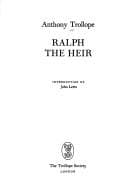
Domestic fiction; England -- Fiction; Fathers and sons -- Fiction; Inheritance and succession -- Fiction
"Of course you will be of use, my dear;--of the greatest use in the
world. That's his affair, and he is the best judge of what will be of
use. You will love him, and other men will envy him, and that will be
everything. Oh dear, I do so hope he will come soon."
"And I,--I almost hope he will not. I shall be so afraid to see him.
The first meeting will be so awful. I shall not dare to look him in
the face."
"But it is all settled."
"No;--not settled, Clary."
"Yes; it is settled. And now I will tell you what I mean when I say I
do not begrudge him to you. That is--; I do not know whether you will
care to be told."
"I care very much, Clary. I should be very unhappy if you did
begrudge me anything."
"Of course you know that our Ralph Newton, as we call him, ought to
have been the heir."
"Oh, yes."
"I needn't explain it all; only,--only--"
"Only he is everything to you. Is it that, Clary?"
"Yes; it is that. He is everything to me. I love him--. Oh, yes, I do
love him! But, Mary, I am not such a happy girl as you are. Sometimes
I think he hardly cares for me."
"But he has asked you to care for him?"
"Well;--I don't know. I think he has. He has told me, I know, that he
loved me dearly,--better than any one."
"And what answer did you make to him, Clary?"
Clarissa had the whole scene on the lawn at Popham Villa so clearly
impressed upon her memory, that an eternity of years, as she thought,
could obliterate no one of its incidents and render doubtful no tone
of his voice, no word that her lover had spoken. His conduct had at
that time been so violent that she had answered him only with tears
and protestations of undying anger. But her tears had been dried,
and her anger had passed away;--while the love remained. Ralph, her
Ralph, of course knew well enough that the tears were dry and the
anger gone. She could understand that he would understand that. But
the love which he had protested, if it were real love, would remain.
And why should she doubt him? The very fact that he was so dear to
her, made such doubts almost disgraceful. And yet there was so much
cause for doubt. Patience doubted. She knew herself that she feared
more than she hoped. She had resolved gallantly that she would be
true to her own heart, even though by such truth she should be
preparing for herself a life of disappointment. She had admitted
the passion, and she would stand by it. In all her fears, too, she
consoled herself by the reflection that her lover was hindered,
not by want of earnestness or want of truth,--but by the state
of his affairs. While he was still in debt, striving to save his
inheritance, but tormented by the growing certainty that it must
pass away from him, how could he give himself up to love-making and
preparations for marriage? Clary made excuses for him which no one
else would have made, and so managed to feed her hopes. "I made him
no answer," she said at last.
"And yet you knew you loved him."
Public-domain text, read in full here on John Shaqi.
Reviews
Reviews
No reviews yet
Be the first to share your thoughts on this work.
Elsewhere in the archive
Join the Discussion
Join the discussion
Sign in to leave a comment or review.
Sign InorCreate an account