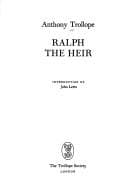
Domestic fiction; England -- Fiction; Fathers and sons -- Fiction; Inheritance and succession -- Fiction
"Clary, dear; we will not think about it. There are things which
should not be thought of. We will not talk of it, but we will love
each other so dearly." Clarissa, now that she was assured that her
evil fortune was not to be aggravated by any injury done to her by
her cousin, allowed herself to be tranquillised if not comforted.
There was indeed something in her position that did not admit of
comfort. All the family knew the story of her unrequited love,
and treated her with a compassion which, while its tenderness was
pleasant to her, was still in itself an injury. A vain attachment in
a woman's heart must ever be a weary load, because she can take no
step of her own towards that consummation by which the burden may be
converted into a joy. A man may be active, may press his suit even a
tenth time, may do something towards achieving success. A woman can
only be still and endure. But Clarissa had so managed her affairs
that even that privilege of being still was hardly left to her. Her
trouble was known to them all. She doubted whether even the servants
in the house did not know the cause of her woe. How all this had
come to pass she could not now remember. She had told Patience,--as
though in compliance with some compact that each should ever tell the
other all things. And then circumstances had arisen which made it so
natural that she should be open and candid with Mary. The two Ralphs
were to be their two lovers. That to her had been a delightful dream
during the last few months. He, whose inheritance at that moment was
supposed to have been gone, had, as Clarissa thought, in plainest
language told his love to her. "Dear, dear Clary, you know I love
you." The words to her sense had been so all-important, had meant
so much, had seemed to be so final, that they hardly wanted further
corroboration. Then, indeed, had come the great fault,--the fault
which she had doubted whether she could ever pardon; and she, because
of the heinousness of that offence, had been unable to answer the
question that had been asked. But the offence, such as it was, had
not lightened the solemnity of her assurance, as far as love went,
that Ralph ought to be her own after the speaking of such words as he
had spoken. There were those troubles about money, but yet she was
entitled to regard him as her own. Then had come the written offer
from the other Ralph to Mary,--the offer written in the moment of
his believed prosperity; and it had been so natural that Clarissa
should tell her cousin that as regarded the splendour of position
there should be no jealousy between them. Clarissa did not herself
think much of a lover who wrote letters instead of coming and
speaking,--had perhaps an idea that open speech, even though offence
might follow, was better than formal letters; but all that was Mary's
affair. This very respectful Ralph was Mary's lover, and if Mary were
satisfied, she would not quarrel with the well-behaved young man. She
Public-domain text, read in full here on John Shaqi.
Reviews
Reviews
No reviews yet
Be the first to share your thoughts on this work.
Elsewhere in the archive
Join the Discussion
Join the discussion
Sign in to leave a comment or review.
Sign InorCreate an account