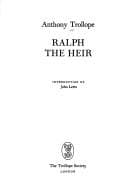
Domestic fiction; England -- Fiction; Fathers and sons -- Fiction; Inheritance and succession -- Fiction
would not even quarrel with him because he was taking from her own
Ralph the inheritance which for so many years had been believed to be
his own. Thus in the plenitude of her affection and in the serenity
of her heart she had told everything to her cousin. And now also her
father knew it all. How this had come to pass she did not think to
inquire. She suspected no harm from Patience. The thing had been so
clear, that all the world might see it. Ralph, that false one, knew
it also. Who could know it so well as he did? Had not those very
words been spoken by him,--been repeated by him? Now she was as one
stricken, where wounds could not be hidden.
On that day Ralph was driven back to town in his cab, in a rather
disheartened condition, and no more was seen or heard of him for the
present at Popham Villa. His late guardian had behaved very ill to
him in telling Mary Bonner the story of Polly Neefit. That was his
impression,--feeling sure that Mary had alluded to the unfortunate
affair with the breeches-maker's daughter, of which she could have
heard tidings only from Sir Thomas. As to Clarissa, he had not
exactly forgotten the little affair on the lawn; but to his eyes that
affair had been so small as to be almost overlooked amidst larger
matters. Mary, he thought, had never looked so beautiful as she had
done while refusing him. He did not mean to give her up. Her heart,
she had told him, was not her own. He thought he had read of young
ladies in similar conditions, of young ladies who had bestowed their
hearts and had afterwards got them back again for the sake of making
second bestowals. He was not sure but that such an object would lend
a zest to life. There was his brother Gregory in love with Clarissa,
and still true to her. He would be true to Mary, and would see
whether, in spite of that far-away lover, he might not be more
successful than his brother. At any rate he would not give her
up,--and before he had gone to bed that night he had already
concocted a letter to her in his brain, explaining the whole of that
Neefit affair, and asking her whether a man should be condemned to
misery for life because he had been led by misfortune into such a
mistake as that. He dined very well at his club, and on the following
morning went down to the Moonbeam by an early train, for that day's
hunting. Thence he returned to Newton Priory in time for Christmas,
and as he was driven up to his own house, through his own park,
meeting one or two of his own tenants, and encountering now and then
his own obsequious labourers, he was not an unhappy man in spite of
Mary Bonner's cruel answer. It may be doubted whether his greatest
trouble at this moment did not arise from his dread of Neefit. He had
managed to stay long enough in London to give orders that Neefit's
money should be immediately paid. He knew that Neefit could not harm
him at law; but it would not be agreeable if the old man were to go
Public-domain text, read in full here on John Shaqi.
Reviews
Reviews
No reviews yet
Be the first to share your thoughts on this work.
Elsewhere in the archive
Join the Discussion
Join the discussion
Sign in to leave a comment or review.
Sign InorCreate an account