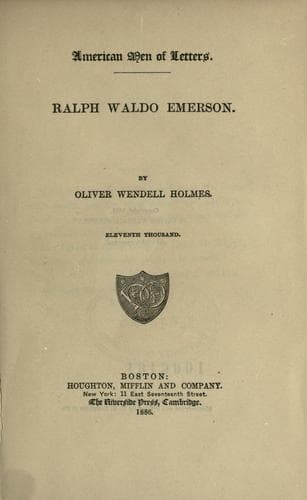
Authors, American -- 19th century -- Biography; Emerson, Ralph Waldo, 1803-1882
"I do not think it yet appears that women wish this equal share in
public affairs. But it is they and not we that are to determine it.
Let the laws he purged of every barbarous remainder, every barbarous
impediment to women. Let the public donations for education be
equally shared by them, let them enter a school as freely as a
church, let them have and hold and give their property as men do
theirs;--and in a few years it will easily appear whether they wish
a voice in making the laws that are to govern them. If you do refuse
them a vote, you will also refuse to tax them,--according to our
Teutonic principle, No representation, no tax.--The new movement
is only a tide shared by the spirits of man and woman; and you may
proceed in the faith that whatever the woman's heart is prompted to
desire, the man's mind is simultaneously prompted to accomplish."
Emerson was fortunate enough to have had for many years as a neighbor,
that true New England Roman, Samuel Hoar. He spoke of him in Concord
before his fellow-citizens, shortly after his death, in 1856. He
afterwards prepared a sketch of Mr. Hoar for "Putnam's Magazine," from
which I take one prose sentence and the verse with which the sketch
concluded:--
"He was a model of those formal but reverend manners which make
what is called a gentleman of the old school, so called under an
impression that the style is passing away, but which, I suppose, is
an optical illusion, as there are always a few more of the class
remaining, and always a few young men to whom these manners are
native."
The single verse I quote is compendious enough and descriptive enough
for an Elizabethan monumental inscription.
"With beams December planets dart
His cold eye truth and conduct scanned;
July was in his sunny heart,
October in his liberal hand."
Emerson's "English Traits," forming one volume of his works, was
published in 1856. It is a thoroughly fresh and original book. It is not
a tourist's guide, not a detailed description of sights which tired
the traveller in staring at them, and tire the reader who attacks the
wearying pages in which they are recorded. Shrewd observation there is
indeed, but its strength is in broad generalization and epigrammatic
characterizations. They are not to be received as in any sense final;
they are not like the verifiable facts of science; they are more or less
sagacious, more or less well founded opinions formed by a fair-minded,
sharp-witted, kind-hearted, open-souled philosopher, whose presence
made every one well-disposed towards him, and consequently left him
well-disposed to all the world.
Public-domain text, read in full here on John Shaqi.
Reviews
Reviews
No reviews yet
Be the first to share your thoughts on this work.
Elsewhere in the archive
Join the Discussion
Join the discussion
Sign in to leave a comment or review.
Sign InorCreate an account