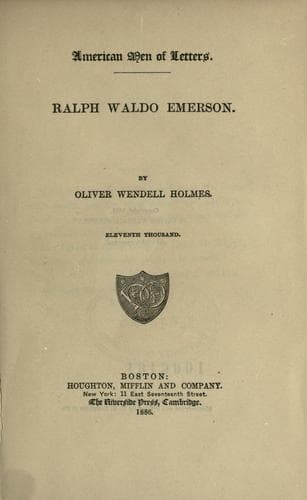
Authors, American -- 19th century -- Biography; Emerson, Ralph Waldo, 1803-1882
A glance at the table of contents will give an idea of the objects which
Emerson proposed to himself in his tour, and which take up the principal
portion of his record. Only one _place_ is given as the heading of a
chapter,--_Stonehenge_. The other eighteen chapters have general titles,
_Land, Race, Ability, Manners_, and others of similar character.
He uses plain English in introducing us to the Pilgrim fathers of the
British Aristocracy:--
"Twenty thousand thieves landed at Hastings. These founders of the
House of Lords were greedy and ferocious dragoons, sons of greedy
and ferocious pirates. They were all alike, they took everything
they could carry; they burned, harried, violated, tortured, and
killed, until everything English was brought to the verge of ruin.
Such, however, is the illusion of antiquity and wealth, that decent
and dignified men now existing boast their descent from these filthy
thieves, who showed a far juster conviction of their own merits by
assuming for their types the swine, goat, jackal, leopard, wolf, and
snake, which they severally resembled."
The race preserves some of its better characteristics.
"They have a vigorous health and last well into middle and old age.
The old men are as red as roses, and still handsome. A clear skin,
a peach-bloom complexion, and good teeth are found all over the
island."
English "Manners" are characterized, according to Emerson, by pluck,
vigor, independence. "Every one of these islanders is an island himself,
safe, tranquil, incommunicable." They are positive, methodical, cleanly,
and formal, loving routine and conventional ways; loving truth and
religion, to be sure, but inexorable on points of form.
"They keep their old customs, costumes, and pomps, their wig and
mace, sceptre and crown. A severe decorum rules the court and the
cottage. Pretension and vaporing are once for all distasteful. They
hate nonsense, sentimentalism, and high-flown expressions; they use
a studied plainness."
"In an aristocratical country like England, not the Trial by Jury,
but the dinner is the capital institution."
"They confide in each other,--English believes in English."--"They
require the same adherence, thorough conviction, and reality in
public men."
"As compared with the American, I think them cheerful and contented.
Young people in this country are much more prone to melancholy."
Emerson's observation is in accordance with that of Cotton Mather nearly
two hundred years ago.
Public-domain text, read in full here on John Shaqi.
Reviews
Reviews
No reviews yet
Be the first to share your thoughts on this work.
Elsewhere in the archive
Join the Discussion
Join the discussion
Sign in to leave a comment or review.
Sign InorCreate an account