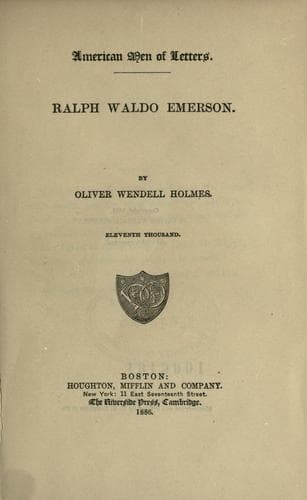
Authors, American -- 19th century -- Biography; Emerson, Ralph Waldo, 1803-1882
Mr. Cabot informs us in his Prefatory Note to "Letters and Social Aims,"
that the proof sheets of this volume, now forming the eighth of the
collected works, showed even before the burning of his house and the
illness which followed from the shock, that his loss of memory and of
mental grasp was such as to make it unlikely that he would in any case
have been able to accomplish what he had undertaken. Sentences, even
whole pages, were repeated, and there was a want of order beyond what
even he would have tolerated:--
"There is nothing here that he did not write, and he gave his
full approval to whatever was done in the way of selection and
arrangement; but I cannot say that he applied his mind very closely
to the matter."
This volume contains eleven Essays, the subjects of which, as just
enumerated, are very various. The longest and most elaborate paper is
that entitled "Poetry and Imagination." I have room for little more than
the enumeration of the different headings of this long Essay. By these
it will be seen how wide a ground it covers. They are "Introductory;"
"Poetry;" "Imagination;" "Veracity;" "Creation;" "Melody, Rhythm, Form;"
"Bards and Trouveurs;" "Morals;" "Transcendency." Many thoughts with
which we are familiar are reproduced, expanded, and illustrated in this
Essay. Unity in multiplicity, the symbolism of nature, and others of his
leading ideas appear in new phrases, not unwelcome, for they look fresh
in every restatement. It would be easy to select a score of pointed
sayings, striking images, large generalizations. Some of these we find
repeated in his verse. Thus:--
"Michael Angelo is largely filled with the Creator that made and
makes men. How much of the original craft remains in him, and he a
mortal man!"
And so in the well remembered lines of "The Problem":--
"Himself from God he could not free."
"He knows that he did not make his thought,--no, his thought made him,
and made the sun and stars."
"Art might obey but not surpass.
The passive Master lent his hand
To the vast soul that o'er him planned."
Hope is at the bottom of every Essay of Emerson's as it was at the
bottom of Pandora's box:--
"I never doubt the riches of nature, the gifts of the future, the
immense wealth of the mind. O yes, poets we shall have, mythology,
symbols, religion of our own.
--"Sooner or later that which is now life shall be poetry, and every
fair and manly trait shall add a richer strain to the song."
Under the title "Social Aims" he gives some wise counsel concerning
manners and conversation. One of these precepts will serve as a
specimen--if we have met with it before it is none the worse for wear:--
"Shun the negative side. Never worry people with; your contritions,
nor with dismal views of politics or society. Never name sickness;
even if you could trust yourself on that perilous topic, beware of
unmuzzling a valetudinarian, who will give you enough of it."
Public-domain text, read in full here on John Shaqi.
Reviews
Reviews
No reviews yet
Be the first to share your thoughts on this work.
Elsewhere in the archive
Join the Discussion
Join the discussion
Sign in to leave a comment or review.
Sign InorCreate an account