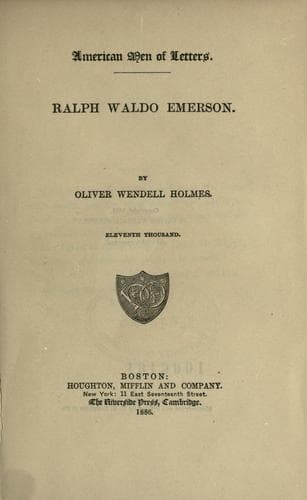
Authors, American -- 19th century -- Biography; Emerson, Ralph Waldo, 1803-1882
We have had one Essay on "Eloquence" already. One extract from this new
discourse on the same subject must serve our turn:--
"These are ascending stairs,--a good voice, winning manners, plain
speech, chastened, however, by the schools into correctness; but
we must come to the main matter, of power of statement,--know your
fact; hug your fact. For the essential thing is heat, and heat comes
of sincerity. Speak what you know and believe; and are personally in
it; and are answerable for every word. Eloquence is _the power to_
_translate a truth into language perfectly intelligible to the
person to whom you speak_."
The italics are Emerson's.
If our learned and excellent John Cotton used to sweeten his mouth
before going to bed with a bit of Calvin, we may as wisely sweeten and
strengthen our sense of existence with a morsel or two from Emerson's
Essay on "Resources":--
"A Schopenhauer, with logic and learning and wit, teaching
pessimism,--teaching that this is the worst of all possible worlds,
and inferring that sleep is better than waking, and death than
sleep,--all the talent in the world cannot save him from being
odious. But if instead of these negatives you give me affirmatives;
if you tell me that there is always life for the living; that what
man has done man can do; that this world belongs to the energetic;
that there is always a way to everything desirable; that every man
is provided, in the new bias of his faculty, with a key to
nature, and that man only rightly knows himself as far as he has
experimented on things,--I am invigorated, put into genial and
working temper; the horizon opens, and we are full of good-will and
gratitude to the Cause of Causes."
The Essay or Lecture on "The Comic" may have formed a part of a series
he had contemplated on the intellectual processes. Two or three sayings
in it will show his view sufficiently:--
"The essence of all jokes, of all comedy, seems to be an honest or
well-intended halfness; a non-performance of what is pretended to
be performed, at the same time that one is giving loud pledges of
performance.
"If the essence of the Comic be the contrast in the intellect
between the idea and the false performance, there is good reason why
we should be affected by the exposure. We have no deeper interest
than our integrity, and that we should be made aware by joke and by
stroke of any lie we entertain. Besides, a perception of the comic
seems to be a balance-wheel in our metaphysical structure. It
appears to be an essential element in a fine character.--A rogue
alive to the ludicrous is still convertible. If that sense is lost,
his fellow-men can do little for him."
These and other sayings of like purport are illustrated by
well-preserved stories and anecdotes not for the most part of very
recent date.
Public-domain text, read in full here on John Shaqi.
Reviews
Reviews
No reviews yet
Be the first to share your thoughts on this work.
Elsewhere in the archive
Join the Discussion
Join the discussion
Sign in to leave a comment or review.
Sign InorCreate an account