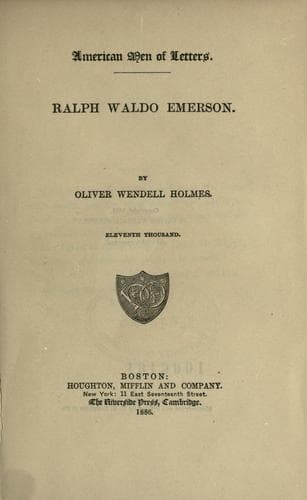
Authors, American -- 19th century -- Biography; Emerson, Ralph Waldo, 1803-1882
I will not quote anything from the Essay called "Aristocracy." But let
him who wishes to know what the word means to an American whose life has
come from New England soil, whose ancestors have breathed New England
air for many generations, read it, and he will find a new interpretation
of a very old and often greatly wronged appellation.
"Perpetual Forces" is one of those prose poems,--of his earlier epoch,
I have no doubt,--in which he plays with the facts of science with
singular grace and freedom.
What man could speak more fitly, with more authority of "Character,"
than Emerson? When he says, "If all things are taken away, I have
still all things in my relation to the Eternal," we feel that such an
utterance is as natural to his pure spirit as breathing to the frame in
which it was imprisoned.
We have had a glimpse of Emerson as a school-master, but behind and far
above the teaching drill-master's desk is the chair from which he speaks
to us of "Education." Compare the short and easy method of the wise man
of old,--"He that spareth his rod hateth his son," with this other, "Be
the companion of his thought, the friend of his friendship, the lover of
his virtue,--but no kinsman of his sin."
"The Superlative" will prove light and pleasant reading after these
graver essays. [Greek: Maedhen agan]--_ne quid nimis_,--nothing in
excess, was his precept as to adjectives.
Two sentences from "The Sovereignty of Ethics" will go far towards
reconciling elderly readers who have not forgotten the Westminster
Assembly's Catechism with this sweet-souled dealer in spiritual
dynamite:--
"Luther would cut his hand off sooner than write theses against the
pope if he suspected that he was bringing on with all his might the
pale negations of Boston Unitarianism.--
"If I miss the inspiration of the saints of Calvinism, or of
Platonism, or of Buddhism, our times are not up to theirs, or, more
truly, have not yet their own legitimate force."
So, too, this from "The Preacher":--
"All civil mankind have agreed in leaving one day for contemplation
against six for practice. I hope that day will keep its honor and
its use.--The Sabbath changes its forms from age to age, but the
substantial benefit endures."
The special interest of the Address called "The Man of Letters" is, that
it was delivered during the war. He was no advocate for peace where
great principles were at the bottom of the conflict:--
"War, seeking for the roots of strength, comes upon the moral
aspects at once.--War ennobles the age.--Battle, with the sword,
has cut many a Gordian knot in twain which all the wit of East and
West, of Northern and Border statesmen could not untie."
"The Scholar" was delivered before two Societies at the University of
Virginia so late as the year 1876. If I must select any of its wise
words, I will choose the questions which he has himself italicized to
show his sense of their importance:--
Public-domain text, read in full here on John Shaqi.
Reviews
Reviews
No reviews yet
Be the first to share your thoughts on this work.
Elsewhere in the archive
Join the Discussion
Join the discussion
Sign in to leave a comment or review.
Sign InorCreate an account