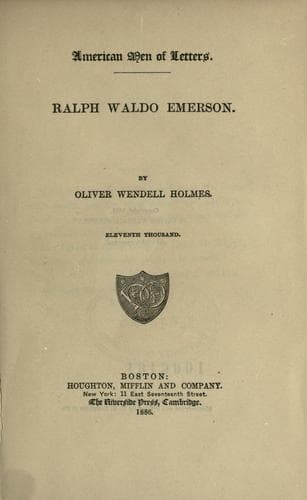
Authors, American -- 19th century -- Biography; Emerson, Ralph Waldo, 1803-1882
"For all men, all women, Time, your country, your condition, the
invisible world are the interrogators: _Who are you? What do you?
Can you obtain what you wish? Is there method in your consciousness?
Can you see tendency in your life? Can you help any soul_?
"Can he answer these questions? Can he dispose of them? Happy if you
can answer them mutely in the order and disposition of your life!
Happy for more than yourself, a benefactor of men, if you can answer
them in works of wisdom, art, or poetry; bestowing on the general
mind of men organic creations, to be the guidance and delight of all
who know them."
The Essay on "Plutarch" has a peculiar value from the fact that Emerson
owes more to him than to any other author except Plato, who is one of
the only two writers quoted oftener than Plutarch. _Mutato nomine_, the
portrait which Emerson draws of the Greek moralist might stand for his
own:--
"Whatever is eminent in fact or in fiction, in opinion, in
character, in institutions, in science--natural, moral, or
metaphysical, or in memorable sayings drew his attention and came to
his pen with more or less fulness of record.
"A poet in verse or prose must have a sensuous eye, but an
intellectual co-perception. Plutarch's memory is full and his
horizon wide. Nothing touches man but he feels to be his.
"Plutarch had a religion which Montaigne wanted, and which defends
him from wantonness; and though Plutarch is as plain spoken, his
moral sentiment is always pure.--
"I do not know where to find a book--to borrow a phrase of Ben
Jonson's--'so rammed with life,' and this in chapters chiefly
ethical, which are so prone to be heavy and sentimental.--His
vivacity and abundance never leave him to loiter or pound on an
incident.--
"In his immense quotation and allusion we quickly cease to
discriminate between what he quotes and what he invents.--'Tis all
Plutarch, by right of eminent domain, and all property vests in this
emperor.
"It is in consequence of this poetic trait in his mind, that I
confess that, in reading him, I embrace the particulars, and carry a
faint memory of the argument or general design of the chapter; but
he is not less welcome, and he leaves the reader with a relish and a
necessity for completing his studies.
"He is a pronounced idealist, who does not hesitate to say, like
another Berkeley, 'Matter is itself privation.'--
"Of philosophy he is more interested in the results than in the
method. He has a just instinct of the presence of a master, and
prefers to sit as a scholar with Plato than as a disputant.
"His natural history is that of a lover and poet, and not of a
physicist.
Public-domain text, read in full here on John Shaqi.
Reviews
Reviews
No reviews yet
Be the first to share your thoughts on this work.
Elsewhere in the archive
Join the Discussion
Join the discussion
Sign in to leave a comment or review.
Sign InorCreate an account