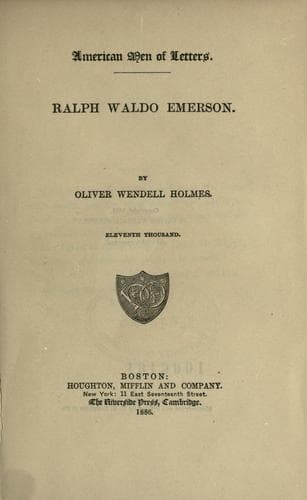
Authors, American -- 19th century -- Biography; Emerson, Ralph Waldo, 1803-1882
"These syllables that Nature spoke,
And the thoughts that in him woke
Can adequately utter none
Save to his ear the wind-harp lone.
Therein I hear the Parcae reel
The threads of man at their humming wheel,
The threads of life and power and pain,
So sweet and mournful falls the strain.
And best can teach its Delphian chord
How Nature to the soul is moored,
If once again that silent string,
As erst it wont, would thrill and ring."
There is no need of quoting any of the poems which have become familiar
to most true lovers of poetry. Emerson saw fit to imitate the Egyptians
by placing "The Sphinx" at the entrance of his temple of song. This poem
was not fitted to attract worshippers. It is not easy of comprehension,
not pleasing in movement. As at first written it had one verse in it
which sounded so much like a nursery rhyme that Emerson was prevailed
upon to omit it in the later versions. There are noble passages in it,
but they are for the adept and not for the beginner. A commonplace young
person taking up the volume and puzzling his or her way along will come
by and by to the verse:--
"Have I a lover
Who is noble and free?--
I would he were nobler
Than to love me."
The commonplace young person will be apt to say or think _c'est
magnifique, mais ce n'est pas_--_l'amour_.
The third poem in the volume, "The Problem," should have stood first in
order. This ranks among the finest of Emerson's poems. All his earlier
verse has a certain freshness which belongs to the first outburst
of song in a poetic nature. "Each and All," "The Humble-Bee," "The
Snow-Storm," should be read before "Uriel," "The World-Soul," or
"Mithridates." "Monadnoc" will be a good test of the reader's taste for
Emerson's poetry, and after this "Woodnotes."
In studying his poems we must not overlook the delicacy of many of their
descriptive portions. If in the flights of his imagination he is
like the strong-winged bird of passage, in his exquisite choice of
descriptive epithets he reminds me of the _tenui-rostrals._ His subtle
selective instinct penetrates the vocabulary for the one word he wants,
as the long, slender bill of those birds dives deep into the flower for
its drop of honey. Here is a passage showing admirably the two different
conditions: wings closed and the selective instinct picking out its
descriptive expressions; then suddenly wings flashing open and the
imagination in the firmament, where it is always at home. Follow the
pitiful inventory of insignificances of the forlorn being he describes
with a pathetic humor more likely to bring a sigh than a smile, and then
mark the grand hyperbole of the last two lines. The passage is from the
poem called "Destiny":--
Public-domain text, read in full here on John Shaqi.
Reviews
Reviews
No reviews yet
Be the first to share your thoughts on this work.
Elsewhere in the archive
Join the Discussion
Join the discussion
Sign in to leave a comment or review.
Sign InorCreate an account