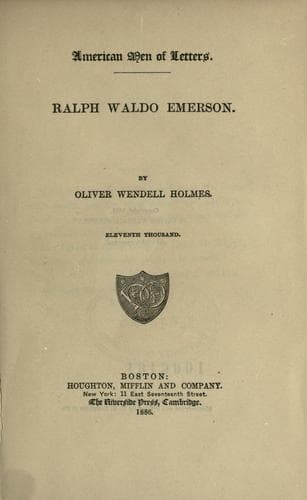
Authors, American -- 19th century -- Biography; Emerson, Ralph Waldo, 1803-1882
"Alas! that one is born in blight,
Victim of perpetual slight:
When thou lookest on his face,
Thy heart saith 'Brother, go thy ways!
None shall ask thee what thou doest,
Or care a rush for what thou knowest.
Or listen when thou repliest,
Or remember where thou liest,
Or how thy supper is sodden;'
And another is born
To make the sun forgotten."
Of all Emerson's poems the "Concord Hymn" is the most nearly complete
and faultless,--but it is not distinctively Emersonian. It is such a
poem as Collins might have written,--it has the very movement and
melody of the "Ode on the Death of Mr. Thomson," and of the "Dirge in
Cymbeline," with the same sweetness and tenderness of feeling. Its one
conspicuous line,
"And fired the shot heard round the world,"
must not take to itself all the praise deserved by this perfect little
poem, a model for all of its kind. Compact, expressive, serene, solemn,
musical, in four brief stanzas it tells the story of the past, records
the commemorative act of the passing day, and invokes the higher Power
that governs the future to protect the Memorial-stone sacred to Freedom
and her martyrs.
These poems of Emerson's find the readers that must listen to them and
delight in them, as the "Ancient Mariner" fastened upon the man who must
hear him. If any doubter wishes to test his fitness for reading them,
and if the poems already mentioned are not enough to settle the
question, let him read the paragraph of "May-Day," beginning,--
"I saw the bud-crowned Spring go forth,"
"Sea-shore," the fine fragments in the "Appendix" to his published
works, called, collectively, "The Poet," blocks bearing the mark of
poetic genius, but left lying round for want of the structural instinct,
and last of all, that which is, in many respects, first of all, the
"Threnody," a lament over the death of his first-born son. This poem has
the dignity of "Lycidas" without its refrigerating classicism, and with
all the tenderness of Cowper's lines on the receipt of his mother's
picture. It may well compare with others of the finest memorial poems in
the language,--with Shelley's "Adonais," and Matthew Arnold's "Thyrsis,"
leaving out of view Tennyson's "In Memoriam" as of wider scope and
larger pattern.
Public-domain text, read in full here on John Shaqi.
Reviews
Reviews
No reviews yet
Be the first to share your thoughts on this work.
Elsewhere in the archive
Join the Discussion
Join the discussion
Sign in to leave a comment or review.
Sign InorCreate an account