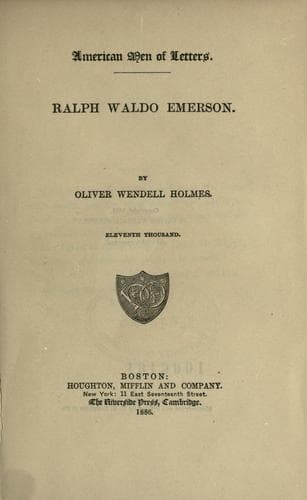
Authors, American -- 19th century -- Biography; Emerson, Ralph Waldo, 1803-1882
Many critics will concede that there is much truth in Mr. Arnold's
remark on the want of "evolution" in Emerson's poems. One is struck
with the fact that a great number of fragments lie about his poetical
workshop: poems begun and never finished; scraps of poems, chips of
poems, paving the floor with intentions never carried out. One cannot
help remembering Coleridge with his incomplete "Christabel," and his
"Abyssinian Maid," and her dulcimer which she never got a tune out of.
We all know there was good reason why Coleridge should have been infirm
of purpose. But when we look at that great unfinished picture over which
Allston labored with the hopeless ineffectiveness of Sisyphus; when we
go through a whole gallery of pictures by an American artist in which
the backgrounds are slighted as if our midsummer heats had taken away
half the artist's life and vigor; when we walk round whole rooms full of
sketches, impressions, effects, symphonies, invisibilities, and other
apologies for honest work, it would not be strange if it should suggest
a painful course of reflections as to the possibility that there may be
something in our climatic or other conditions which tends to scholastic
and artistic anaemia and insufficiency,--the opposite of what we find
showing itself in the full-blooded verse of poets like Browning and on
the flaming canvas of painters like Henri Regnault. Life seemed lustier
in Old England than in New England to Emerson, to Hawthorne, and to
that admirable observer, Mr. John Burroughs. Perhaps we require another
century or two of acclimation.
Emerson never grappled with any considerable metrical difficulties.
He wrote by preference in what I have ventured to call the normal
respiratory measure,--octosyllabic verse, in which one common expiration
is enough and not too much for the articulation of each line. The "fatal
facility" for which this verse is noted belongs to it as recited and
also as written, and it implies the need of only a minimum of skill and
labor. I doubt if Emerson would have written a verse of poetry if he had
been obliged to use the Spenserian stanza. In the simple measures he
habitually employed he found least hindrance to his thought.
Every true poet has an atmosphere as much as every great painter. The
golden sunshine of Claude and the pearly mist of Corot belonged to their
way of looking at nature as much as the color of their eyes and hair
belonged to their personalities. So with the poets; for Wordsworth the
air is always serene and clear, for Byron the sky is uncertain between
storm and sunshine. Emerson sees all nature in the same pearly mist
that wraps the willows and the streams of Corot. Without its own
characteristic atmosphere, illuminated by
"The light that never was on sea or land,"
we may have good verse but no true poem. In his poetry there is not
merely this atmosphere, but there is always a mirage in the horizon.
Public-domain text, read in full here on John Shaqi.
Reviews
Reviews
No reviews yet
Be the first to share your thoughts on this work.
Elsewhere in the archive
Join the Discussion
Join the discussion
Sign in to leave a comment or review.
Sign InorCreate an account