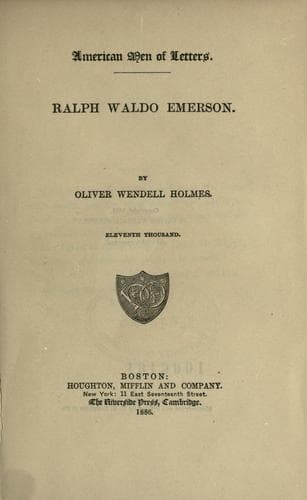
Authors, American -- 19th century -- Biography; Emerson, Ralph Waldo, 1803-1882
I have not lost my reverence for Emerson in showing one of his fancies
for a moment in the distorting mirror of the ridiculous. He would
doubtless have smiled with me at the reflection, for he had a keen sense
of humor. But I take the opportunity to disclaim a jesting remark about
"a foresmell of the Infinite" which Mr. Conway has attributed to me, who
am innocent of all connection with it.
The mystic appeals to those only who have an ear for the celestial
concords, as the musician only appeals to those who have the special
endowment which enables them to understand his compositions. It is
not for organizations untuned to earthly music to criticise the great
composers, or for those who are deaf to spiritual harmonies to criticise
the higher natures which lose themselves in the strains of divine
contemplation. The bewildered reader must not forget that passage of
arms, previously mentioned, between Plato and Diogenes.
* * * * *
Emerson looked rather askance at Science in his early days. I remember
that his brother Charles had something to say in the "Harvard Register"
(1828) about its disenchantments. I suspect the prejudice may have come
partly from Wordsworth. Compare this verse of his with the lines of
Emerson's which follow it.
"Physician art thou, one all eyes;
Philosopher, a fingering slave,
One that would peep and botanize
Upon his mother's grave?"
Emerson's lines are to be found near the end of the Appendix in the new
edition of his works.
"Philosophers are lined with eyes within,
And, being so, the sage unmakes the man.
In love he cannot therefore cease his trade;
Scarce the first blush has overspread his cheek,
He feels it, introverts his learned eye
To catch the unconscious heart in the very act.
His mother died,--the only friend he had,--
Some tears escaped, but his philosophy
Couched like a cat, sat watching close behind
And throttled all his passion. Is't not like
That devil-spider that devours her mate
Scarce freed from her embraces?"
The same feeling comes out in the Poem "Blight," where he says the
"young scholars who invade our hills"
"Love not the flower they pluck, and know it not,
And all their botany is Latin names;"
and in "The Walk," where the "learned men" with their glasses are
contrasted with the sons of Nature,--the poets are no doubt meant,--much
to the disadvantage of the microscopic observers. Emerson's mind
was very far from being of the scientific pattern. Science is
quantitative,--loves the foot-rule and the balance,--methodical,
exhaustive, indifferent to the beautiful as such. The poet is curious,
asks all manner of questions, and never thinks of waiting for the
answer, still less of torturing Nature to get at it. Emerson wonders,
for instance,--
"Why Nature loves the number five,"
Public-domain text, read in full here on John Shaqi.
Reviews
Reviews
No reviews yet
Be the first to share your thoughts on this work.
Elsewhere in the archive
Join the Discussion
Join the discussion
Sign in to leave a comment or review.
Sign InorCreate an account