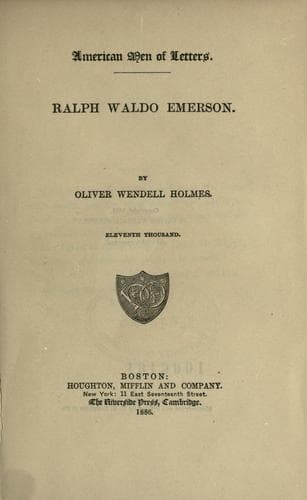
Authors, American -- 19th century -- Biography; Emerson, Ralph Waldo, 1803-1882
but leaves his note of interrogation without troubling himself any
farther. He must have picked up some wood-craft and a little botany
from Thoreau, and a few chemical notions from his brother-in-law, Dr.
Jackson, whose name is associated with the discovery of artificial
anaesthesia. It seems probable that the genial companionship of Agassiz,
who united with his scientific genius, learning, and renown, most
delightful social qualities, gave him a kinder feeling to men of science
and their pursuits than he had entertained before that great master came
among us. At any rate he avails himself of the facts drawn from their
specialties without scruple when they will serve his turn. But he loves
the poet always better than the scientific student of nature. In his
Preface to the Poems of Mr. W.E. Channing, he says:--
"Here is a naturalist who sees the flower and the bud with a poet's
curiosity and awe, and does not count the stamens in the aster, nor the
feathers in the wood-thrush, but rests in the surprise and affection
they awake."--
This was Emerson's own instinctive attitude to all the phenomena of
nature.
Emerson's style is epigrammatic, incisive, authoritative, sometimes
quaint, never obscure, except when he is handling nebulous subjects.
His paragraphs are full of brittle sentences that break apart and are
independent units, like the fragments of a coral colony. His imagery is
frequently daring, leaping from the concrete to the abstract, from the
special to the general and universal, and _vice versa_, with a bound
that is like a flight. Here are a few specimens of his pleasing
_audacities_:--
"There is plenty of wild azote and carbon unappropriated, but it is
naught till we have made it up into loaves and soup."--
"He arrives at the sea-shore and a sumptuous ship has floored and
carpeted for him the stormy Atlantic."--
"If we weave a yard of tape in all humility and as well as we can, long
hereafter we shall see it was no cotton tape at all but some galaxy
which we braided, and that the threads were Time and Nature."--
"Tapping the tempest for a little side wind."--
"The locomotive and the steamboat, like enormous shuttles, shoot
every day across the thousand various threads of national descent and
employment and bind them fast in one web."--
Public-domain text, read in full here on John Shaqi.
Reviews
Reviews
No reviews yet
Be the first to share your thoughts on this work.
Elsewhere in the archive
Join the Discussion
Join the discussion
Sign in to leave a comment or review.
Sign InorCreate an account