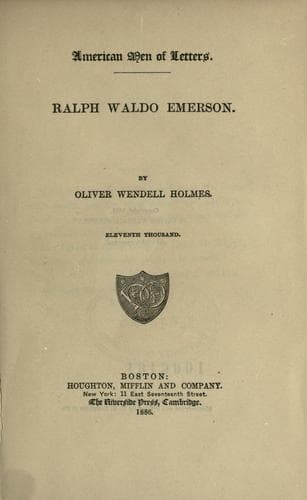
Authors, American -- 19th century -- Biography; Emerson, Ralph Waldo, 1803-1882
He is fond of certain archaisms and unusual phrases. He likes
the expression "mother-wit," which he finds in Spenser, Marlowe,
Shakespeare, and other old writers. He often uses the word "husband"
in its earlier sense of economist. His use of the word "haughty" is so
fitting, and it sounds so nobly from his lips, that we could wish its
employment were forbidden henceforth to voices which vulgarize it. But
his special, constitutional, word is "fine," meaning something like
dainty, as Shakespeare uses it,--"my dainty Ariel,"--"fine Ariel." It
belongs to his habit of mind and body as "faint" and "swoon" belong to
Keats. This word is one of the ear-marks by which Emerson's imitators
are easily recognized. "Melioration" is another favorite word of
Emerson's. A clairvoyant could spell out some of his most characteristic
traits by the aid of his use of these three words; his inborn
fastidiousness, subdued and kept out of sight by his large charity and
his good breeding, showed itself in his liking for the word "haughty;"
his exquisite delicacy by his fondness for the word "fine," with a
certain shade of meaning; his optimism in the frequent recurrence of the
word "melioration."
We must not find fault with his semi-detached sentences until we quarrel
with Solomon and criticise the Sermon on the Mount. The "point and
surprise" which he speaks of as characterizing the style of Plutarch
belong eminently to his own. His fertility of illustrative imagery is
very great. His images are noble, or, if borrowed from humble objects,
ennobled by his handling. He throws his royal robe over a milking-stool
and it becomes a throne. But chiefly he chooses objects of comparison
grand in themselves. He deals with the elements at first hand. Such
delicacy of treatment, with such breadth and force of effect, is hard to
match anywhere, and we know him by his style at sight. It is as when the
slight fingers of a girl touch the keys of some mighty and many-voiced
organ, and send its thunders rolling along the aisles and startling
the stained windows of a great cathedral. We have seen him as an
unpretending lecturer. We follow him round as he "peddles out all the
wit he can gather from Time or from Nature," and we find that "he has
changed his market cart into a chariot of the sun," and is carrying
about the morning light as merchandise.
* * * * *
Public-domain text, read in full here on John Shaqi.
Reviews
Reviews
No reviews yet
Be the first to share your thoughts on this work.
Elsewhere in the archive
Join the Discussion
Join the discussion
Sign in to leave a comment or review.
Sign InorCreate an account